How to Use Snyder Notation in Sudoku
The Complete Guide to Use Cases, Technique & Examples
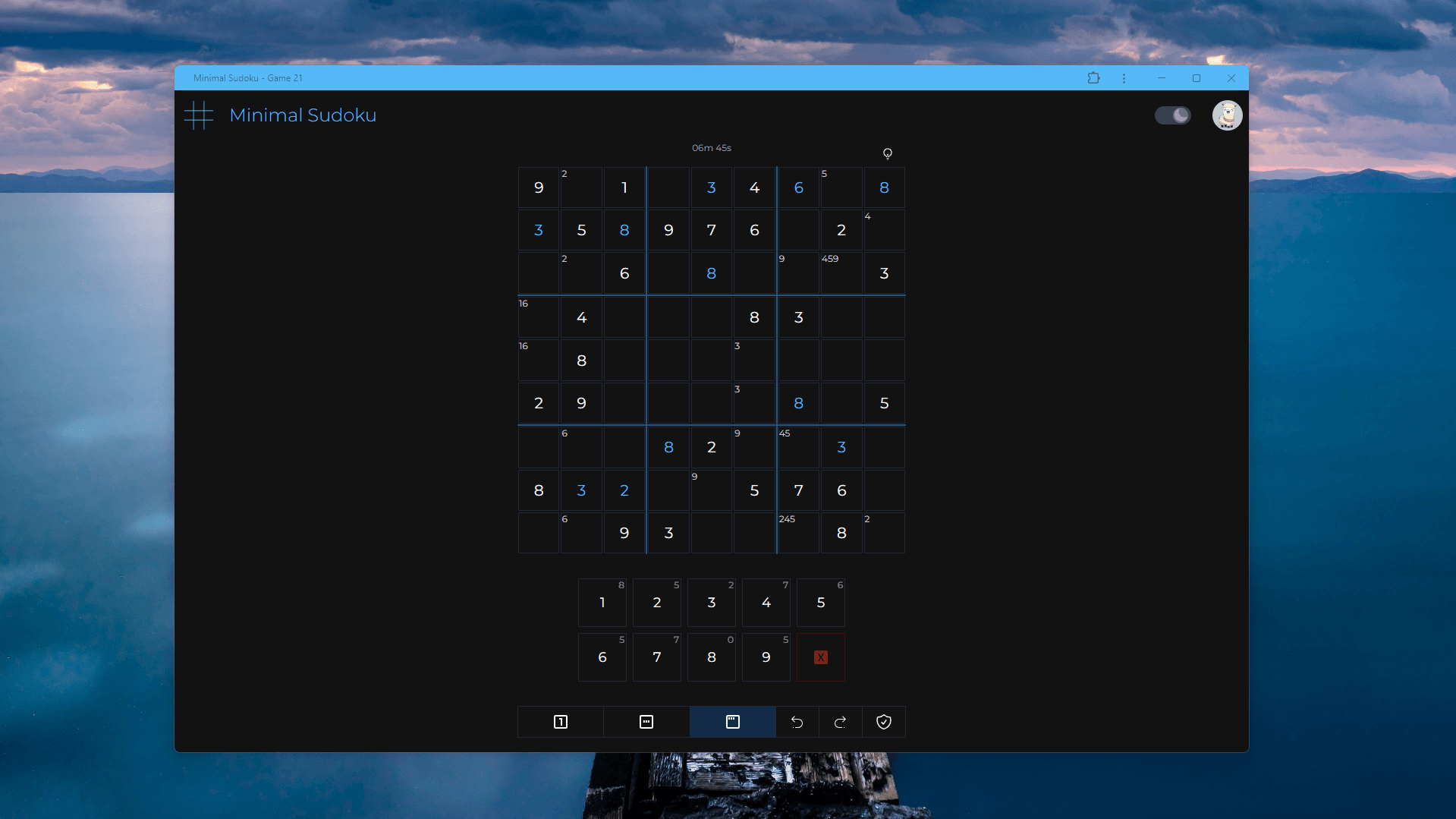
Snyder Notation is a Sudoku pencil-marking technique where you only write candidates when a number can appear in exactly two cells within a 3×3 box. This minimal approach reduces clutter, speeds up pattern recognition, and is the method of choice for competitive solvers worldwide.
- What: Mark candidates only when a number has exactly 2 possible cells in a box
- Why: Less clutter = faster pattern recognition
- Who: Developed by Thomas Snyder, 4x World Sudoku Champion
- Best for: Easy to medium puzzles, or as a starting strategy for harder ones
Who Invented Snyder Notation?
Snyder Notation was developed by Thomas Snyder, widely regarded as the greatest competitive Sudoku solver in history. His credentials speak for themselves:
- 4x World Sudoku Champion (2007, 2008, 2009, 2011)
- 3x World Puzzle Champion — the only person to hold both world titles simultaneously
- Author of numerous puzzle books including "The Art of Sudoku" series
- Currently manages the World Sudoku and Puzzle Championships
- Writes puzzles for the U.S. Sudoku Team qualifiers
Snyder developed this notation system to optimize his own competitive solving. The technique strips away unnecessary information, leaving only the most actionable candidates visible — exactly what you need when solving under time pressure.
The Golden Rule of the Technique
This rule leverages a fundamental Sudoku constraint: every number 1–9 must appear exactly once in each row, column, and box. By tracking only bi-value situations, you're focusing on the moments when placement decisions become actionable.
Snyder Notation Use Cases: When to Use It
Snyder Notation shines in specific use cases and situations during your solve:
- • Boxes with 5–6 givens already filled
- • Early-to-mid game phases
- • Easy to medium difficulty puzzles
- • Speed solving competitions
- • Sparse opening grids (2–3 givens per box)
- • Expert puzzles requiring chains
- • Techniques needing full candidates
How to Use the Snyder Notation Technique: Step by Step
To effectively utilize the Snyder notation technique, follow these methodical steps to build momentum without cluttering your board.
Target blocks with many givens
Scan methodically and place candidates
Place marks in cell corners
Watch for emerging patterns
Update after each placement
Level 1: The Basics
The number 4 cannot appear in the top row or the left column because of other 4s outside this box. Tap the correct cells to mark candidate "4" using Snyder Notation.
Snyder Notation Technique Examples
As you work through the grid, you’ll discover how easy it is to identify vital patterns that crack your puzzle wide open. Here are practical examples of the technique in action.
Example 1: Basic Bi-Value Marking
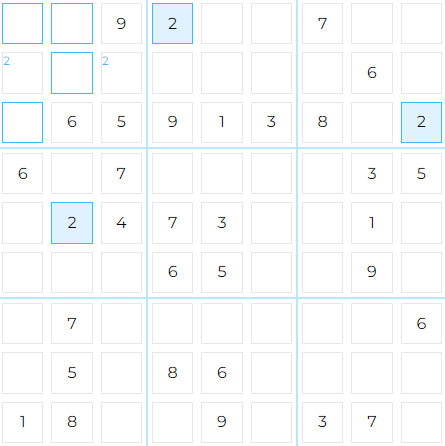
In this example, the number 2 can only go in two cells within the top-left box: R2C1 and R2C3. We mark both cells with a small "2" in the corner.
Notice what this immediately tells us: 2 cannot appear elsewhere in row 2 outside this box. This is a pointing pair — and we spotted it just by applying Snyder!
Example 2: Cross-Box Elimination with Pointing Pairs
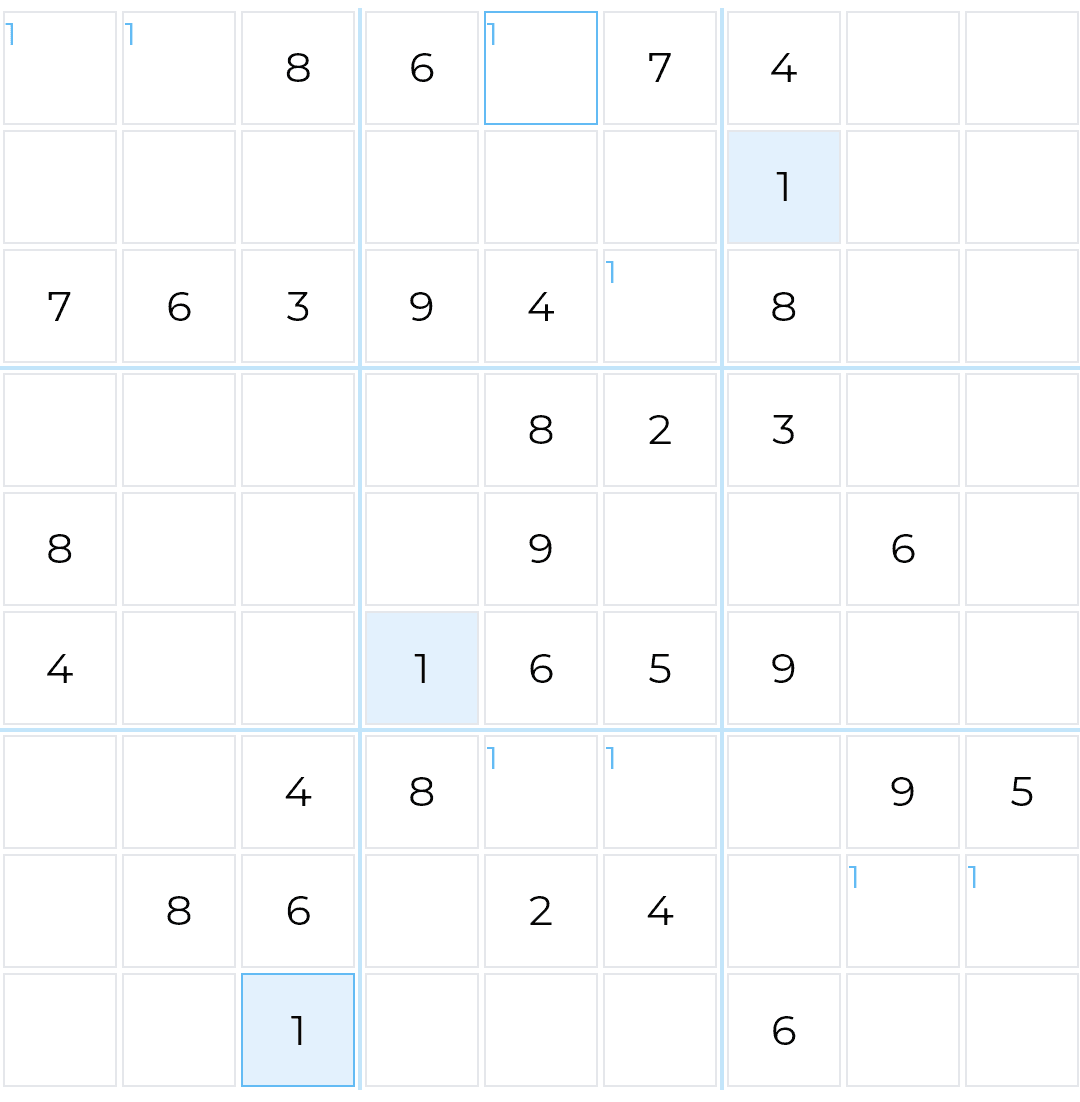
Here we have Snyder marks for the number 1 in box 1 (row 1, columns 1–3) and box 2 (row 1, column 5 and row 3, column 6).
The key insight: The marks in box 1 tell us 1 must be in row 1 of that box. This creates a pointing pair, which eliminates 1 from row 1 of box 2, meaning 1 must go in R3C6.
Pattern Recognized: Pointing pairs and cross-box interactions are exactly what Snyder is built to expose quickly — minimal marks, maximum information.
Example 3: Creating a Cascade of Moves with Snyder Notation
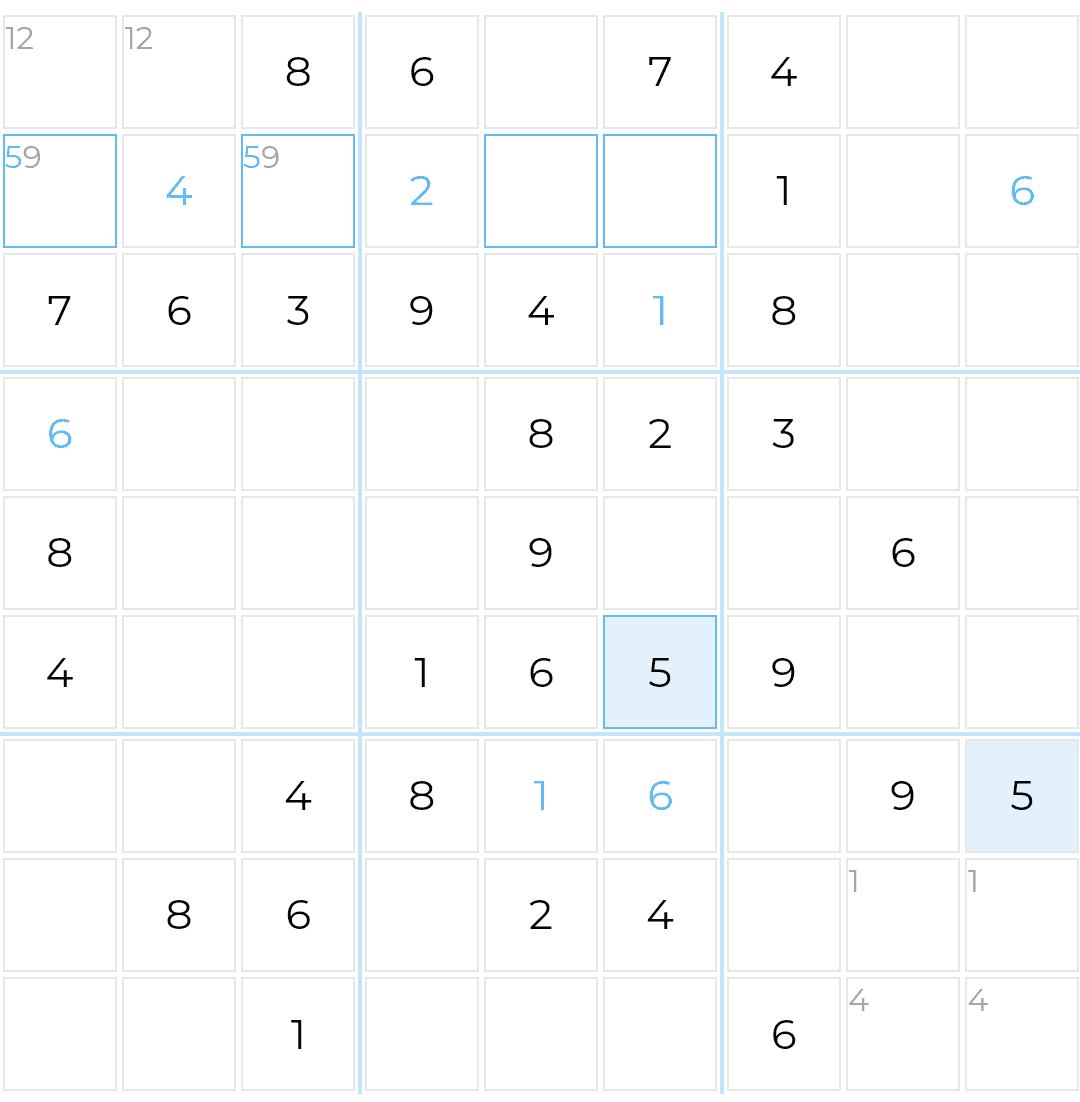
This advanced example shows the real power of the Snyder Notation Sudoku technique. By marking candidates for 1, 2, 5, and 9 in box 1, we can build a chain of deductions:
- 1 and 2 must occupy row 1 of box 1
- Therefore, the remaining two cells must contain 5 and 9
- Looking at the Snyder marks for 5: row 2 is eliminated in box 2
- Only one cell remains for 5 in box 2: R1C5 = 5
This "cascade" of logic is much harder to see with full notation, where the grid becomes cluttered. Snyder keeps it clean.
Pro Tips for Accuracy
Because you only place a candidate when it has just two possibilities, it’s easy to scan the puzzle and think you’ve discovered naked singles — cells where only one answer remains. When using Snyder notation, a cell may have other candidates, but they simply aren’t marked!
Always verify that a cell is truly a naked single by ensuring all other candidates have been safely eliminated before placing the final correct digit.
Watch for Hidden Singles
When you've placed two Snyder marks for a candidate and later eliminate one through solving, the remaining mark is a hidden single — place that number immediately! Check if any of your Snyder pairs have been reduced to singles after every placement.
Integrate Snyder into Scanning
Don't treat Snyder as a separate phase after scanning. Mark candidates during your normal scanning process. When you're checking where a number can go and find exactly two cells in a box, mark them right then to keep your flow smooth.
Rescan After Each Placement
After placing a number, the candidate landscape changes. A number that had 3 options might now have exactly 2 — a new Snyder opportunity. Build the habit of rescanning affected boxes after each placement.
Advanced Applications & Strategies
Identify Pointing Pairs to Eliminate Candidates with Snyder Notation
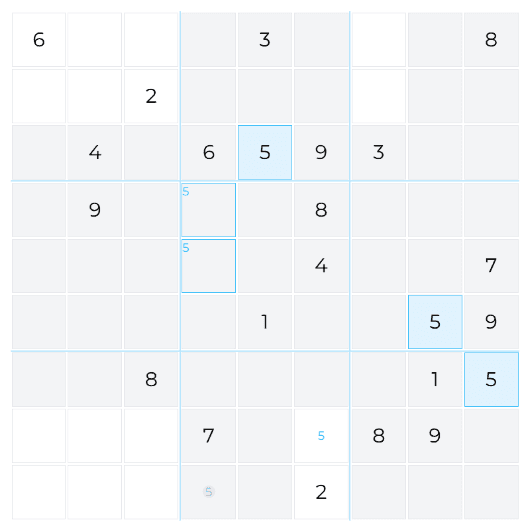
Snyder notation helps you spot and use pointing pairs to eliminate candidates. A pointing pair occurs when a candidate appears in only two cells within a block, and both cells are in the same row or column. This lets you eliminate that candidate from the rest of the row or column outside the block.
Example: If 4 is marked in R5C7 and R5C9 (same box, same row), then 4 cannot appear in R5C1 through R5C6. This often triggers immediate placements.
Advanced Practice: The Pointing Pair
Part 1: Look at the highlighted Top-Left box. Find exactly two spots where the number 8 can go, and tap them to leave Snyder marks.
 Intermediate
Pointing Pairs & Triples
Master this essential technique that Snyder Notation makes easy to spot.
Spotting Naked Singles & Hidden Pairs with Snyder Notation
This technique can make naked singles and hidden pairs shine like neon signs, but proceed with caution. Since you don’t note all possible candidates within a block when using Snyder notation, always cross-reference the rows and columns to confirm your deductions.
Snyder makes hidden pairs obvious: if you see cells marked with only "3,7" and "3,7" in a box, those cells must contain 3 and 7. Identifying naked singles simply requires finding an empty cell in a box and checking to see if all other candidates have been accounted for.
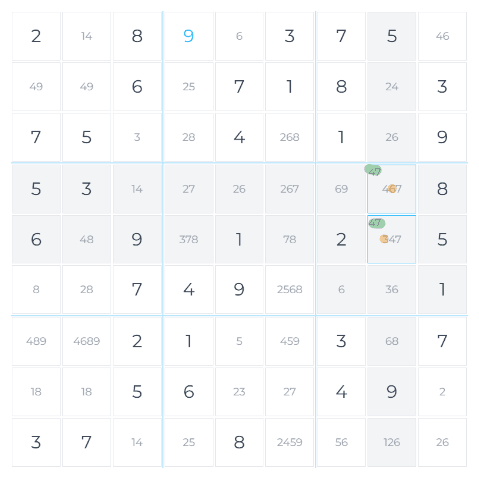 Intermediate
Hidden Pairs
Learn to find candidates that only appear in two cells within a unit.
Transitioning to Full Notation
For harder puzzles, you may need to switch from Snyder to full candidate notation. The best approach:
- Use Snyder until you're stuck
- Fill in all candidates for the remaining cells
- Apply advanced techniques like X-Wing or XY-Chains
This hybrid method gives you Snyder's speed advantage while preserving access to advanced techniques when needed.
Snyder vs Full Notation
| Aspect | Snyder Notation | Full Notation |
|---|---|---|
| Marks per cell | Usually 0–2 | Often 3–6 |
| Grid clutter | Low | High |
| Setup time | Fast | Slow |
| Pattern visibility | Excellent for pairs | Required for chains |
| Best difficulty | Easy → Medium | Hard → Expert |
| Speed solving | Preferred | Too slow |
Why the Snyder Notation Technique Works
The technique's power comes from three principles:
By only marking pairs, every pencil mark holds massive value. You stop tracking useless numbers and focus only on what matters.
Fewer marks mean patterns like pointing pairs and hidden singles pop out immediately instead of hiding in a sea of numbers.
A clean grid prevents mental fatigue. You spend your energy solving the puzzle logically, not managing a messy board.
Practice Snyder Notation
Ready to try it? The best way to learn Snyder Notation is through practice. Start with an easy or medium puzzle and focus on applying the rule consistently.
Try Snyder Notation Now
Practice on our free online Sudoku with built-in candidate mode perfect for Snyder marking.
Play Free SudokuFrequently Asked Questions (FAQ)
What is Snyder Notation in Sudoku?
Snyder Notation is a minimal pencil-marking technique where you only track a candidate number if it can go in exactly two possible cells within a single 3x3 block. This eliminates grid clutter and highlights advanced patterns faster.
Who invented the Snyder method?
The method was developed and popularized by Thomas Snyder, a legendary competitive solver who won the World Sudoku Championship four times. He created this systematic marking method to maximize speed in competition.
Can you use Snyder notation for expert Sudoku puzzles?
Yes, but often mixed with full notation. High-level solvers use Snyder notation early to place easy numbers and spot basic constraints. Once they hit a roadblock in a harder puzzle, they transition to full candidate notation to find complex patterns like X-Wings or Chains.
How do I spot Naked Singles with Snyder notation?
You must be careful! Because Snyder notation only notes bi-value candidates, an empty cell might look like a Naked Single when other unmarked candidates actually exist. To truly spot Naked Singles, make sure you use Sudoku scanning to verify that all other 8 digits are blocked from that specific cell.