
Hidden Single
Find Where a Number Must Go
The Hidden Single is one of the most powerful beginner techniques in Sudoku. Instead of asking "what can go in this cell?", it asks "where can this number go in this row/column/box?"
- What: A digit that can only appear in one cell within a row, column, or box
- How: Check where a specific digit can go — if only one cell works, that's the answer
- Difficulty: Beginner — essential technique for all puzzles
- Also called: Pinned Digit, Unique Position
The Concept
Every row, column, and 3×3 box must contain each digit from 1 to 9 exactly once. The Hidden Single technique uses this rule in reverse: if a digit can only go in one cell within a unit, it must go there.
The digit is "hidden" because the cell might have other candidates too — it doesn't look special at first glance. But within its row, column, or box, it's the only cell where that digit can appear.
The Golden Rule
How to Find Hidden Singles
Pick a unit to analyze
Pick a digit (1-9)
Find all possible cells
Count the possibilities
Place the digit
Practical Example
Finding a Hidden Single in a Box
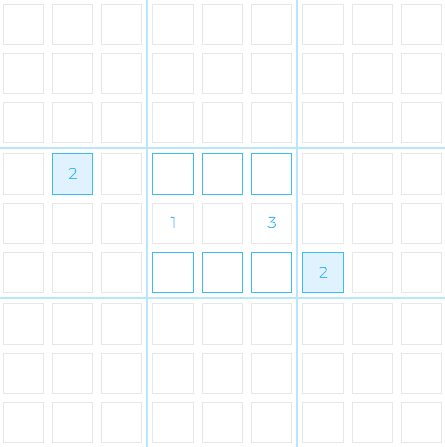
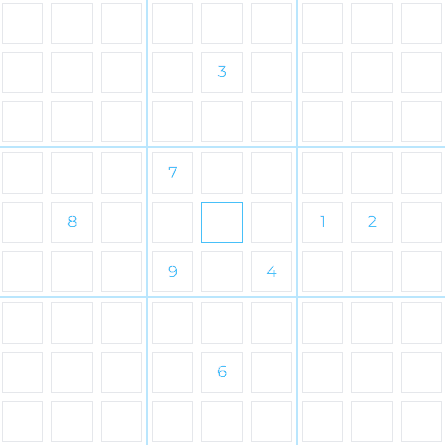
Let's look at the center box and try to place the digit 7.
First, we identify empty cells in the box. Then we check which ones can contain 7:
- R4C4: 7 appears in row 4 → eliminated
- R4C6: 7 appears in row 4 → eliminated
- R5C5: Already filled
- R6C4: 7 appears in column 4 → eliminated
- R6C5: No conflicts → possible!
- R6C6: 7 appears in column 6 → eliminated
Three Types of Hidden Singles
Hidden Singles can occur in any of the three unit types:
A digit can only go in one cell within a row.
"Where can 5 go in row 3?"
A digit can only go in one cell within a column.
"Where can 5 go in column 7?"
A digit can only go in one cell within a 3×3 box.
"Where can 5 go in the center box?"
Hidden Single vs Naked Single
These two techniques complement each other perfectly:
Focus: The cell
"What can go in this cell?" → Only one option left.
Focus: The digit
"Where can this digit go?" → Only one cell available.
A good solver uses both techniques together. When one doesn't find anything, switch to the other!
 Beginner
Naked Single
Learn the complementary technique: finding cells where only one digit is possible.