
X-Wing
The Classic Fish Pattern for Candidate Elimination
The X-Wing is one of the most famous advanced Sudoku strategies. It's the simplest member of the "Fish" family and a gateway to more complex patterns like Swordfish and Jellyfish.
- What: A rectangle pattern of 4 cells containing the same candidate
- Where: 2 rows × 2 columns, with exactly 2 candidates per row (or column)
- Result: Eliminate that candidate from other cells in the aligned columns (or rows)
- Difficulty: Advanced — requires full candidate notation
The Concept
An X-Wing occurs when a candidate appears in exactly two cells in each of two different rows (or columns), and those cells align perfectly — forming a rectangle.
The pattern can be found two ways:
Find 2 rows where a candidate appears in exactly 2 cells, aligned in the same columns.
→ Eliminate from those columns
Find 2 columns where a candidate appears in exactly 2 cells, aligned in the same rows.
→ Eliminate from those rows
The Golden Rule
How to Find an X-Wing
Find a candidate with exactly 2 positions
Find a matching row or column
Verify the rectangle
Eliminate candidates
Practical Example
X-Wing on Digit 7
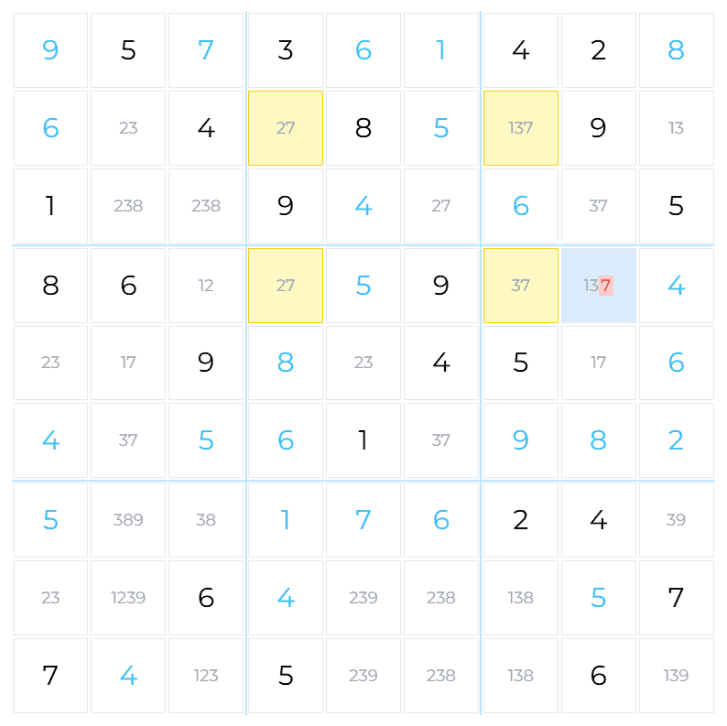
In this example, we've found a column-based X-Wing for the digit 7:
- Column 4: Digit 7 appears only in rows 2 and 4
- Column 7: Digit 7 also appears only in rows 2 and 4
The 4 cells at R2C4, R2C7, R4C4, and R4C7 form a perfect rectangle. Since 7 must occupy exactly one cell in each column, and both columns are locked to rows 2 and 4, we know:
Why It Works
The logic is elegant: the candidate must appear somewhere in each column (or row). Since it can only go in two spots per column, and those spots align in the same two rows, the candidate is "locked" into those four cells.
One of the two diagonals will be the solution — either (R2C4 and R4C7) or (R2C7 and R4C4). We don't need to know which one! Either way, rows 2 and 4 are "claimed" by this X-Wing for digit 7, so we can safely eliminate 7 from any other cell in those rows.
Detection Tips
Related Strategies
X-Wing is the foundation of the "Fish" family. Once you've mastered it, you can tackle its larger cousins:
Fish Family
 Advanced
Swordfish
The 3×3 extension of X-Wing. Same logic, but with 3 rows and 3 columns.