
XY-Chain
Open Chains Through Bi-Value Cells
XY-Chain extends Y-Wing logic to longer paths. You connect bi-value cells into a chain and use the chain to force eliminations.
- What: A chain of bi-value cells where neighbors share one candidate
- Main Rule: If endpoints share candidate X and the chain guarantees at least one endpoint is X, remove X from cells seeing both endpoints
- Result: Open-chain endpoint elimination
- Difficulty: Expert — best after Y-Wing
When to Use XY-Chain
Use XY-Chain when easier techniques stop working and your grid has many cells with exactly two candidates.
Practical trigger:
"Can I connect two same-digit endpoints through a valid bi-value chain?"
The Concept
An XY-Chain is a path of bi-value cells (cells with exactly two candidates). Each link in the path must share one candidate, and linked cells must see each other (same row, column, or box).
- Candidate: a penciled-in possible digit.
- Endpoint: the first or last cell of a chain.
The Golden Rule
Chain length alone does not make a chain valid. Correct if/then logic does.
Chain Structure
How to Apply XY-Chains
Find bi-value cells
Build links
Extend the chain
Validate endpoints
Eliminate
Worked Example
XY-Chain on Candidate 9
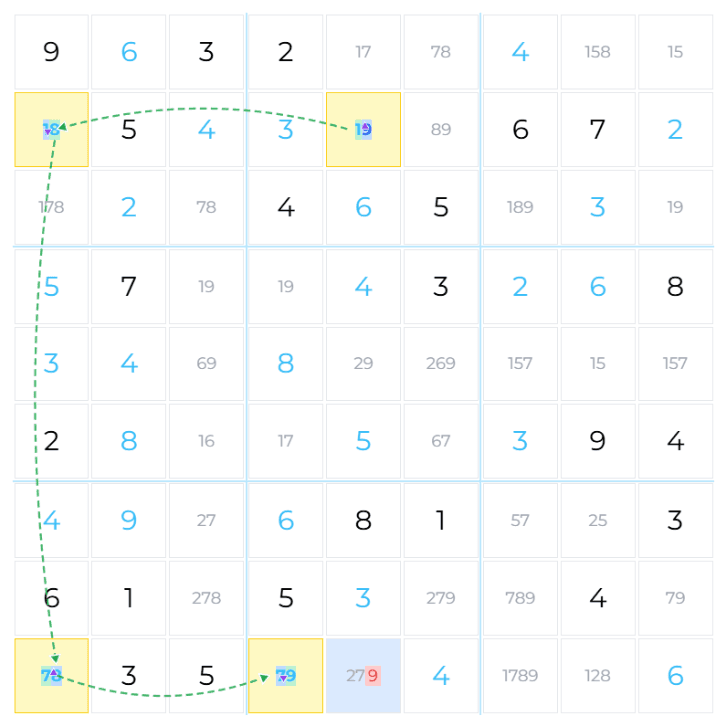
Chain:
R2C5 [9/1] → R2C1 [1/8] → R9C1 [8/7] → R9C4 [7/9]
Endpoints R2C5 and R9C4 both include 9, and the chain guarantees at least one endpoint must be 9.
Why It Works
XY-Chain uses either/or logic on the endpoint candidate:
- If one endpoint is not X, the chain forces the other endpoint to X.
- If one endpoint is X directly, the rule is already satisfied.
Therefore, at least one endpoint must be X, so any third cell that sees both endpoints cannot keep X.
Detection Tips
Related Techniques
XY-Chain sits between Y-Wing and broader chain frameworks:
Chain Techniques
ExpertClosed XY-Chains (Part 2)
Learn what changes when XY-Chains close into loop behavior.