
Pointing Pairs & Triples
When Box Candidates Point to Line Eliminations
Pointing Pairs and Pointing Triples are elegant techniques that exploit the interaction between boxes and lines. When a candidate within a box is confined to a single row or column, it "points" to eliminations outside the box.
- What: A candidate in a box appears only in one row or column
- Result: Eliminate that candidate from the rest of the row/column outside the box
- Pointing Pair: Candidate in exactly 2 cells on the line
- Pointing Triple: Candidate in exactly 3 cells on the line
- Difficulty: Intermediate — works great with Snyder Notation
The Concept
Every 3×3 box must contain each digit 1-9. If we look at where a specific digit can go within a box, sometimes all possible cells fall on the same row or column.
When this happens, we know the digit will definitely be placed somewhere on that line within this box. This means it cannot appear elsewhere on the same line — giving us eliminations outside the box.
Box 1:              Row extends beyond box:
┌───────────┐
│ . │ . │ . │
│───│───│───│
│[5]│[5]│ . │  →→→  │ ✗ │ ✗ │ ✗ │ ✗ │ ✗ │ ✗ │
│───│───│───│
│ . │ . │ . │       (eliminate 5 from rest of row)
└───────────┘
The Golden Rule
How to Find Pointing Pairs
Pick a box
Pick a candidate
Find all possible cells
Check alignment
Eliminate outside the box
Practical Example
Pointing Pair on Digit 5
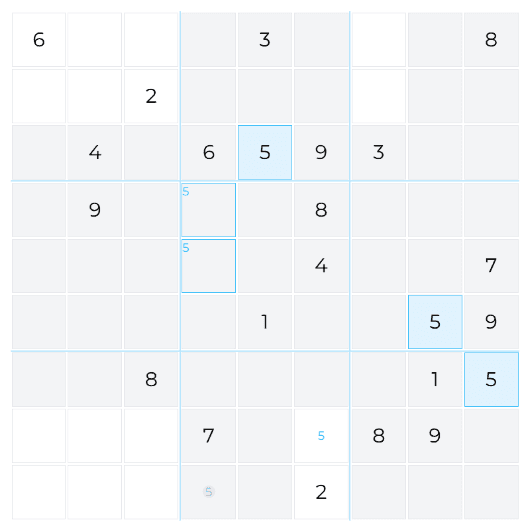
In the top-left box (Box 1), let's look for where digit 5 can go:
- R1C1: 5 appears in column 1 → eliminated
- R1C2: 5 appears in row 1 → eliminated
- R1C3: 5 appears in row 1 → eliminated
- R2C1: No conflicts → possible
- R2C2: No conflicts → possible
- R2C3: 5 appears in column 3 → eliminated
- R3C1-C3: Various conflicts → eliminated
The candidate 5 can only go in R2C1 or R2C2 — both in row 2!
Why It Works
The logic is straightforward:
- Box 1 must contain a 5 somewhere.
- Within Box 1, the only cells where 5 can go are in row 2.
- Therefore, row 2's 5 will definitely be in Box 1.
- Since a row can only have one 5, no other cell in row 2 can contain 5.
Pointing vs Claiming Pairs
Pointing Pairs and Claiming Pairs are mirror techniques:
Start in a box, find candidates aligned on a line.
Eliminate from the line (outside the box).
Start on a line, find candidates confined to one box.
Eliminate from the box (outside the line).
Together, they form the "Locked Candidates" family — techniques that use the intersection of boxes and lines.
IntermediateClaiming Pairs
The reverse technique: when line candidates are confined to one box.