Hidden Pairs
Find the Pairs Hiding Among Other Candidates
Hidden Pairs occur when two candidates appear in only two cells within a unit — but those cells also contain other candidates that "hide" the pair. Once found, you can eliminate all other candidates from those two cells.
- What: Two candidates that appear in exactly two cells within a unit
- Why "hidden": The cells have other candidates that obscure the pair
- Result: Remove all other candidates from those two cells
- Difficulty: Intermediate — harder to spot than Naked Pairs
The Concept
In every row, column, or box, each digit must appear exactly once. If two specific digits can only go in the same two cells within a unit, those cells must contain those digits — nothing else.
The pair is "hidden" because the cells usually have other candidates too. The key insight is looking at where specific digits can go, not what's in the cells.
The Golden Rule
How to Find Hidden Pairs
Pick a unit to analyze
Count candidate positions
Find digits with only 2 positions
Find matching pairs
Eliminate other candidates
Practical Example
Hidden Pair on 4 and 9
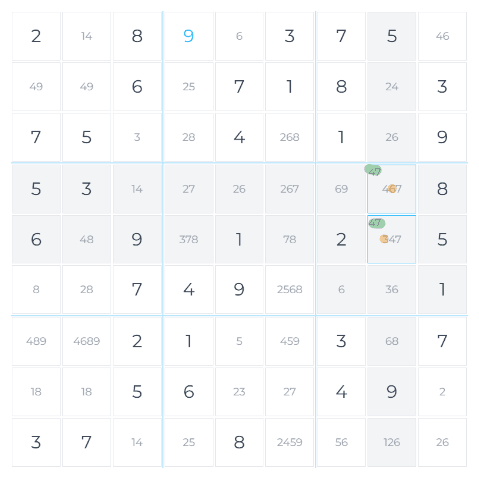
In row 5, let's check where digits 4 and 9 can go:
- Digit 4: Can only go in R5C3 or R5C7
- Digit 9: Can only go in R5C3 or R5C7
Both digits are limited to the exact same two cells! These cells might also contain other candidates (like 2, 5, 8), but that doesn't matter.
After elimination, the cells become a Naked Pair (4,9) — which may enable further eliminations!
Hidden Pairs vs Naked Pairs
These techniques are two sides of the same coin:
Two cells have only the same two candidates.
Eliminate those candidates from other cells in the unit.
Two candidates appear only in the same two cells.
Eliminate other candidates from those cells.
 Intermediate
Naked Pairs
Learn the complementary technique that works from the opposite direction.
Hidden Triples & Quads
Like Naked Sets, Hidden Sets extend to larger groups:
2 digits in exactly 2 cells
3 digits in exactly 3 cells
4 digits in exactly 4 cells
 Intermediate
Hidden Triples & Quads
Extend the Hidden Pair concept to find even more complex patterns.