
Simple Coloring
Track Candidates Through Strong Links
Simple Coloring is a powerful technique that tracks a single digit through strong-link chains using two colors. When the two opposing colors create a contradiction or trap, you can eliminate candidates or place digits.
- What: Track one digit through strong-link chains
- Colors: Two alternating colors represent either/or positions
- Results: Find contradictions (eliminate one color) or traps (cells seen by both colors)
- Difficulty: Advanced — requires understanding strong links
The Concept
Simple Coloring focuses on one digit at a time. For that digit, we find cells connected by strong links and alternate two colors through the chain. If one color is TRUE, the other is FALSE.
By tracing these chains, we can find:
- Two cells of the same color that see each other (contradiction)
- An uncolored cell that sees both colors (can be eliminated)
The Golden Rule
Understanding Strong Links
You may also see Simple Coloring referred to as Single's Chains.
How to Find Coloring Moves
Choose a digit
Find strong links
Start coloring
Extend the chain
Look for patterns
Practical Example
Simple Coloring on Digit 4
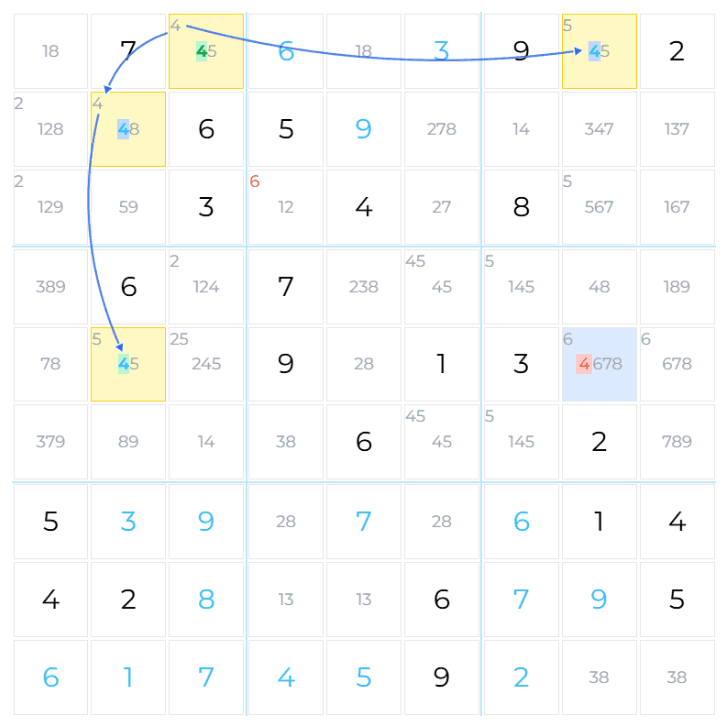
In this grid, candidate 4 forms strong links including:
- In column 2, 4 can only go in R2C2 and R5C2.
- In row 1, 4 can only go in R1C3 and R1C8.
The cell R5C8 sees both opposing chain ends R5C2 and R1C8.
Through the intervening strong links shown in the diagram, R5C2 and R1C8 are opposite colors in the same chain.
Why It Works
Simple Coloring relies on alternating truth values across strong links:
- One color is true, and the opposite color is false.
- If the same color appears twice in one row, column, or box, that color is impossible everywhere in that chain.
- If an uncolored candidate sees both colors, it is impossible regardless of which color ends up true.
Detection Tips
Related Techniques
Simple Coloring is the foundation for more advanced chain techniques:
When a coloring chain closes into a loop, the interpretation overlaps with X-Cycle logic (and can be viewed as a nice-loop style pattern in AIC terms).
Chain Techniques
ExpertX-Cycle
Extend coloring to include weak links for even more powerful deductions.