X-Cycle
Part 1: Fundamentals and Continuous Loops
X-Cycle extends Simple Coloring by combining strong links and weak links on one digit. This page focuses on the core foundation: continuous loops and how they produce eliminations.
- What: A single-digit chain with alternating strong and weak links
- Core Pattern: Continuous loops (no flaw) with even length
- Main Result: Eliminate candidates that see two opposite same-digit chain endpoints
- Progression: Learn this first, then move to discontinuous loops
The Concept
X-Cycle is a chain technique where each candidate is treated as either ON or OFF, and each link carries a logical consequence to the next candidate.
In this Part 1 article, we focus on loops that alternate perfectly all the way around (continuous loops). These are the easiest X-Cycles to trust and apply.
Core Principle
Strong vs Weak Links
Exactly 2 cells have the candidate in a unit.
If one is FALSE → other is TRUE
If one is TRUE → other is FALSE
3+ cells have the candidate in a unit.
If one is TRUE → other is FALSE
If one is FALSE → other is UNKNOWN
Continuous Loops
A continuous X-Cycle has no break in alternation. It must have an even number of nodes, and you can start at any node and traverse either direction.
- Continuous loops usually do not place a value directly on a loop node.
- They eliminate candidates outside the loop that see both members of an opposite either/or pair on the chain.
- This is the same logic family as Simple Coloring traps, but with strong and weak links mixed.
+9[B3]-9[B8]+9[H8]-9[H3]+9[B3]

This is a continuous X-Cycle (X-Wing structure):
- Strong and weak links alternate all the way around
- The loop closes cleanly with no discontinuity
- Use it to remove off-chain 9s that see both relevant loop nodes
Worked Continuous Example
Continuous X-Cycle on Digit 3 (8-node loop)
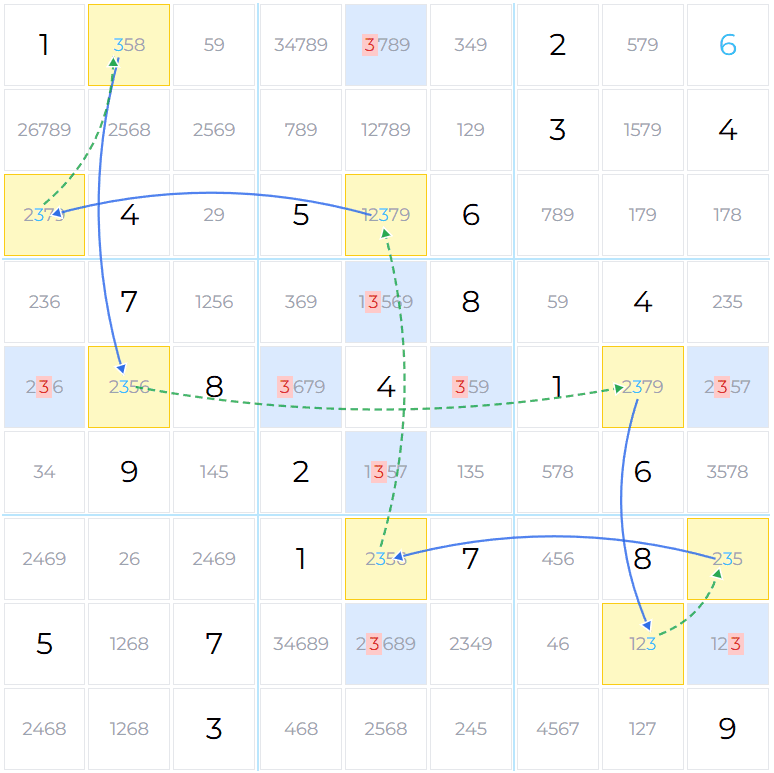
This position shows a continuous X-Cycle on candidate 3 with 8 loop nodes (an even-length loop).
Because the chain alternates cleanly with no discontinuity, it acts as an elimination engine: off-chain 3-candidates can be removed whenever they see both members of an opposite either/or pair on the chain.
Classic Patterns Inside X-Cycle
Some named patterns are just short continuous X-Cycles:
- X-Wing: continuous X-Cycle with 4 nodes.
- 2-2-2 Swordfish: continuous X-Cycle with 6 nodes.
- Thinking in X-Cycles helps you see these as one consistent chain framework.
How to Find X-Cycles
Choose one digit
Mark conjugate pairs first
Connect with weak links
Check alternation and parity
Harvest off-chain eliminations
Common Mistakes
Next Step
After continuous loops, the next skill is discontinuous X-Cycles. That is where you get direct placements (strong-strong) and discontinuity-node eliminations (weak-weak).
Related Techniques
Chain Techniques
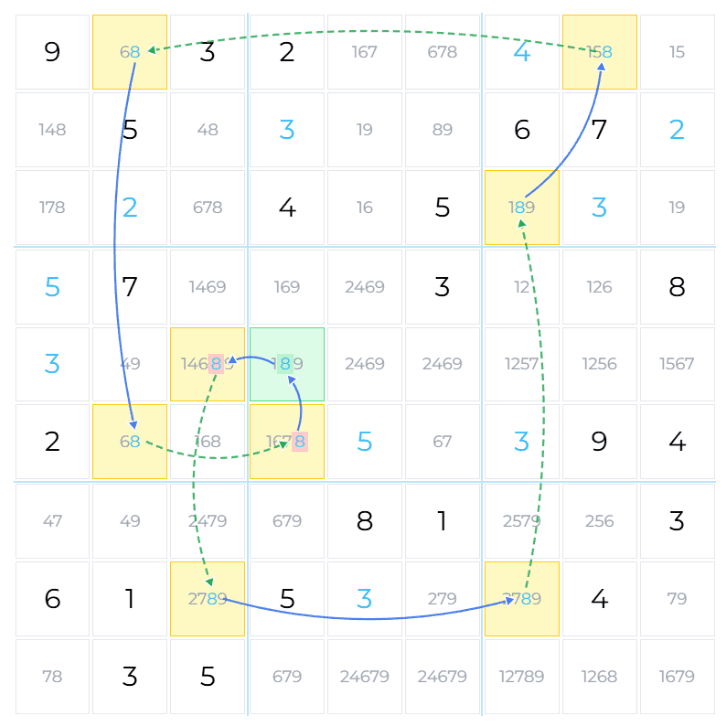 Expert
X-Cycle Discontinuous Loops
Learn the two discontinuity outcomes: strong-strong placement and weak-weak elimination.
ExpertAlternating Inference Chains
Generalize X-Cycle ideas to multi-digit chain logic.