Swordfish
The 3×3 Fish Pattern for Advanced Elimination
The Swordfish is the 3×3 extension of the X-Wing pattern. While X-Wing uses 2 rows and 2 columns, Swordfish uses 3 rows and 3 columns — making it more powerful but harder to spot.
- What: A candidate confined to 3 columns across 3 rows (or vice versa)
- Pattern: 6–9 cells forming a 3×3 grid alignment
- Result: Eliminate that candidate from other cells in the aligned rows or columns
- Difficulty: Hard — requires careful pattern recognition
The Concept
A Swordfish occurs when a candidate appears in at most 3 positions in each of 3 different rows (or columns), and all those positions align within the same 3 columns (or rows).
Unlike X-Wing which always has exactly 4 cells, a Swordfish can have anywhere from 6 to 9 cells — not all positions in the 3×3 grid need to be filled.
Find 3 rows where a candidate appears in only 2–3 cells each, all within the same 3 columns.
→ Eliminate from those columns
Find 3 columns where a candidate appears in only 2–3 cells each, all within the same 3 rows.
→ Eliminate from those rows
The Golden Rule
How to Find a Swordfish
Find rows with limited candidates
Find two more matching rows
Verify the alignment
Eliminate candidates
Practical Example
Swordfish on Digit 8
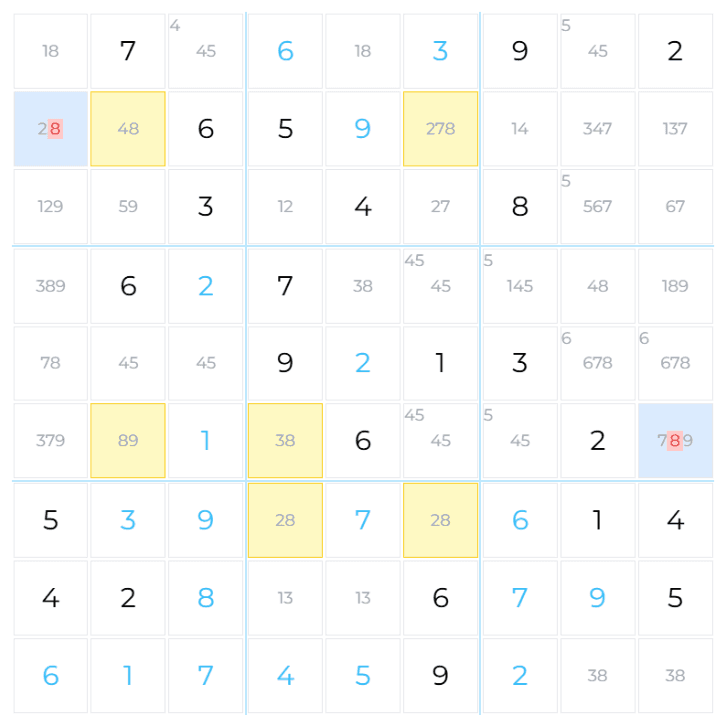
In this example, we've found a column-based Swordfish for the digit 8:
- Column 2: Digit 8 appears only in rows 2, 6, and 7
- Column 4: Digit 8 appears only in rows 2, 6, and 7
- Column 6: Digit 8 appears only in rows 2, 6, and 7
All three columns have their 8s confined to the same three rows. This means rows 2, 6, and 7 will each contain exactly one 8 from these columns.
Why It Works
The logic extends directly from X-Wing. In each of the 3 columns, the candidate must appear somewhere. Since it can only go in cells within rows 2, 6, or 7, those three rows will "absorb" all three 8s — one per column.
We don't need to know exactly which cell in each column gets the 8. We just know that between them, rows 2, 6, and 7 will claim all three 8s from these columns. Therefore, no other cell in those rows can contain an 8.
Fish Family Comparison
| Pattern | Size | Difficulty |
|---|---|---|
| X-Wing | 2 rows × 2 columns | 🟡 Medium |
| Swordfish | 3 rows × 3 columns | 🟠 Hard |
| Jellyfish | 4 rows × 4 columns | 🔴 Expert |
Each fish pattern follows the same logic — just at different scales. Master X-Wing first, then Swordfish becomes a natural extension.
Detection Tips
Related Strategies
Swordfish sits in the middle of the Fish family. Understanding its relationship to X-Wing and Jellyfish helps solidify the underlying logic.
Fish Family
 Advanced
X-Wing
Start here if you haven't mastered the 2×2 fish pattern yet. Same logic, simpler to spot.
 Expert
Jellyfish
Ready for more? The 4×4 fish pattern is rare but powerful when you find it.