
3D Medusa
Multi-Digit Coloring Through Bi-Value Cells
Simple Coloring assigns two colors to one digit along chains of cells. 3D Medusa extends this by connecting different digits through bi-value cells, building larger coloring networks and unlocking eliminations that single-digit coloring cannot find.
- What: Color candidates across multiple digits using two alternating colors
- New link: Bi-value cells (exactly 2 candidates) bridge between digits
- Result: Eliminations (kill trapped candidates) or contradictions (solve entire color)
How It Works
The chain uses two types of strong link:
- Bi-location: A digit appears in exactly 2 cells in a row, column, or box. One must be true, the other false → opposite colors.
- Bi-value: A cell has exactly 2 candidates. One must be true, the other false → opposite colors. This is the “3D” bridge that lets the chain jump between digits.
To build a chain: pick any candidate on a strong link, color it blue, color the other end green, and keep following all strong links (both bi-location and bi-value), alternating colors until no more links remain. Then check for eliminations and contradictions.
Elimination
For each uncolored candidate, ask two questions:
- Would blue kill it? Yes if: a blue peer has the same digit (external), or the same cell has blue on any digit (internal).
- Would green kill it? Same logic with green.
If both answers are yes, the candidate is dead no matter what. Eliminate it.
Example: Elimination
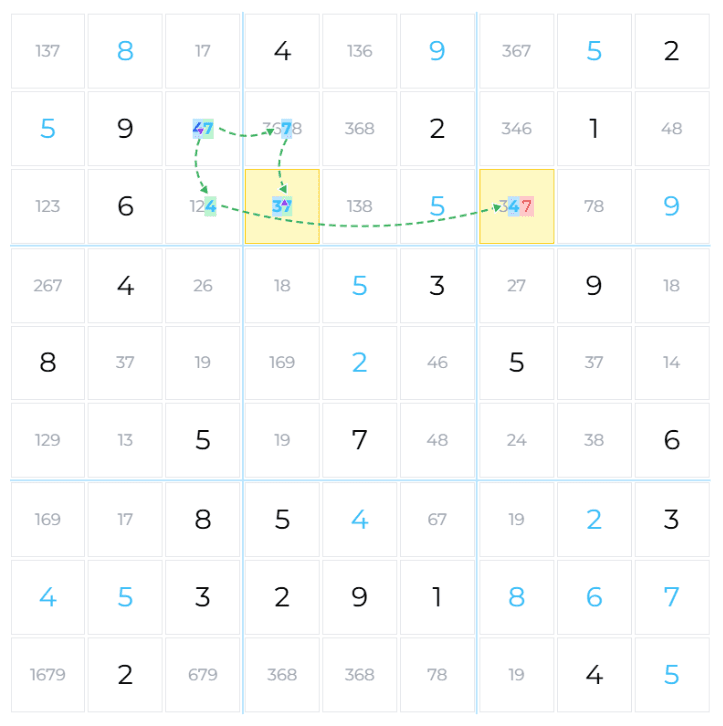
Let's walk through a real example. Focus on the top-left area of this board:
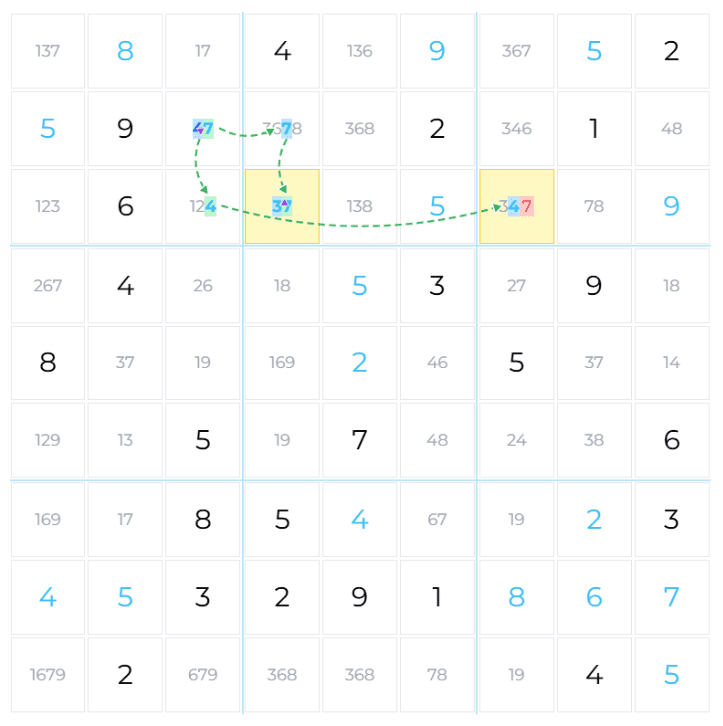
The chain spans 5 cells and 3 digits. The yellow cells directly cause the elimination.
Step 1: Start at a bi-value cell
Cell R2C3 has exactly two candidates: 4 and 7. Color 4 blue and 7 green. (The choice is arbitrary.)
Step 2: Build the chain
From R2C3, the chain branches into two paths:
The chain has 7 colored candidates across 5 cells and 3 digits. No contradictions found — check for eliminations.
Step 3: Find the elimination
Cell R3C7 has candidates {3, 4, 7}. Candidate 4 is colored (🔵 blue), but 7 is uncolored. Can both colors kill it?
Either way, candidate 7 cannot survive. Eliminate it. R3C7 is reduced to {3, 4}.
Contradiction
A color contradicts itself if any of these occur:
The cell would need two values — impossible.
The unit would contain a duplicate — impossible.
Every candidate in a cell would be eliminated — impossible.
Contradictions are rarer than eliminations but far more powerful — they can solve dozens of cells in one move.
Example: Contradiction
This example shows the immense power of a contradiction. The chain spans 47 colored candidates connected by 73 links — far too large to build by hand, but the solver handles it automatically.
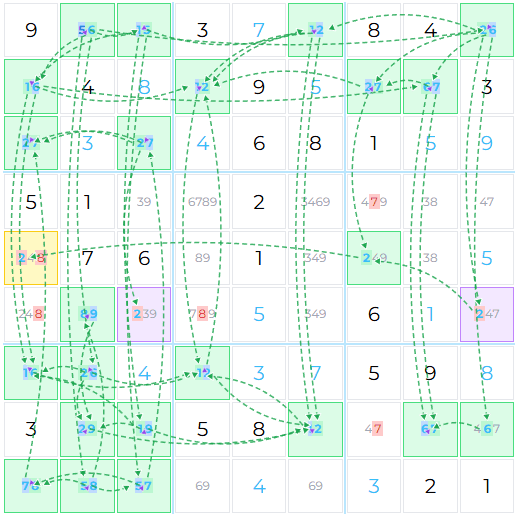
Purple cells: the contradiction. Green candidates: solved. Red candidates: eliminated.
The contradiction
Digit 2 appears as 🔵 blue in two cells in the same row:
Both in row 6. If blue were true, row 6 would have digit 2 twice — impossible.
The payoff
Blue is false, so 🟢 green is true. Every green candidate is solved, every blue candidate is eliminated: 23 cells solved in one move.
Tips
- Start from Simple Coloring. Build single-digit chains first, then look for bi-value cells that bridge to other digits.
- Check contradictions before eliminations. Contradictions are far more powerful — always check for them first.
- Only use strong links. A unit with 3+ cells for a digit has no bi-location link. A cell with 3+ candidates has no bi-value link.
Simple Coloring is a special case of 3D Medusa where no bi-value links are used. If the chain stays on one digit, you are effectively doing Simple Coloring.
Related Techniques
 Advanced
Simple Coloring
Master single-digit coloring before tackling 3D Medusa.