
XYZ-Wing
When the Pivot Has All Three Candidates
The XYZ-Wing is an extension of the Y-Wing pattern. The difference? The pivot cell contains all three candidates (X, Y, and Z) instead of just two.
- Pivot: Contains candidates X, Y, Z (three candidates)
- Wing 1: Contains X, Z (sees pivot)
- Wing 2: Contains Y, Z (sees pivot)
- Result: Eliminate Z from cells that see all three (pivot + both wings)
- Difficulty: Advanced
The Concept
An XYZ-Wing uses three cells with a specific candidate arrangement:
Candidates: X, Y, Z
Has all three
Candidates: X, Z
Sees pivot
Candidates: Y, Z
Sees pivot
All three cells share candidate Z. The elimination happens in cells that can see all three cells.
XYZ-Wing vs Y-Wing
Pivot has 2 candidates (A, B)
Wings don't see each other
Eliminate from cells seeing both wings
Pivot has 3 candidates (X, Y, Z)
Wings must see pivot (can see each other)
Eliminate from cells seeing all three
The Golden Rule
How to Find XYZ-Wings
Find tri-value cells
Find matching wings
• Wing 1 with candidates X, Z
• Wing 2 with candidates Y, Z
Identify the common candidate
Find elimination targets
Eliminate Z
Practical Example
XYZ-Wing on Candidates 4, 7, 8
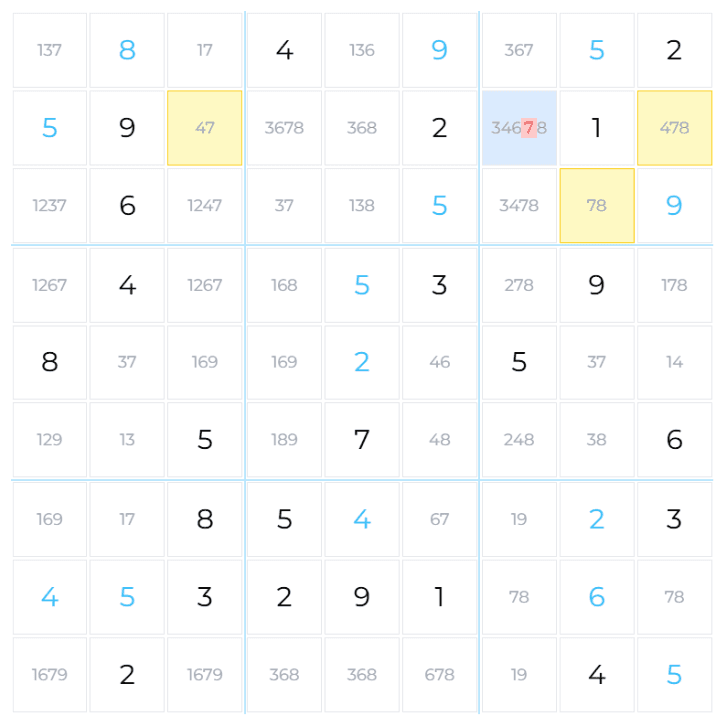
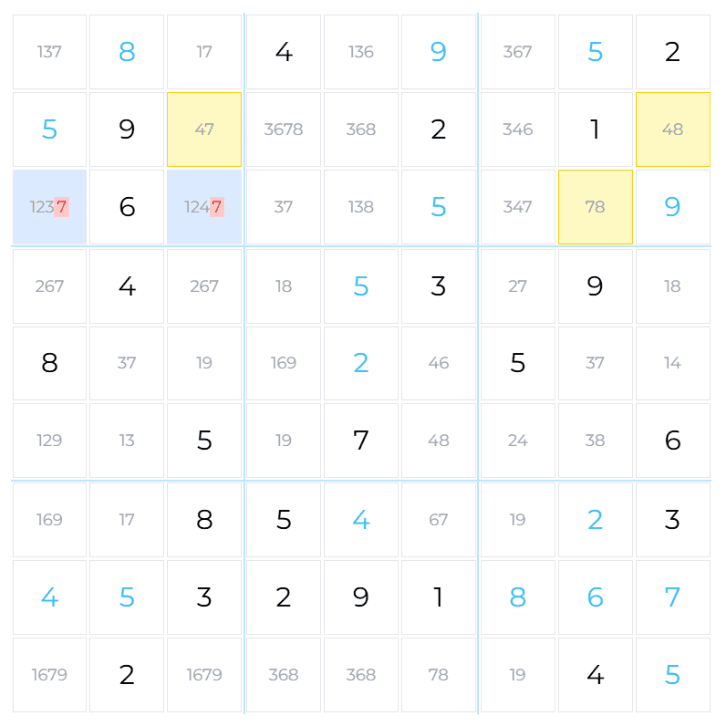
In this example, we have an XYZ-Wing with:
- Pivot at R2C9: Candidates 4, 7, 8 (the tri-value cell)
- Wing 1 at R2C3: Candidates 4, 7 (sees pivot via row 2)
- Wing 2 at R3C8: Candidates 7, 8 (sees pivot via box 3)
The common candidate shared by all three cells is 7. This is our elimination target.
Logic: The pivot must be 4, 7, or 8. If it's 4, Wing 1 becomes 7. If it's 8, Wing 2 becomes 7. If it's 7, the pivot itself is 7. In all cases, one of these three cells contains 7!
Why It Works
Consider the three possible values for the pivot (which has candidates 4, 7, 8):
- If Pivot = 4: Wing 1 (with 4, 7) must become 7.
- If Pivot = 8: Wing 2 (with 7, 8) must become 7.
- If Pivot = 7: The pivot itself is 7.
In all three cases, at least one of the three cells becomes 7. Any cell seeing all three will always "see" a 7 — so we can eliminate 7 from those cells.
Detection Tips
Related Techniques
Wing Family
 Advanced
Y-Wing
Master the simpler Y-Wing first — same logic but with a bi-value pivot.