The WXYZ-Wing is an extension of XYZ-Wing that uses four cells instead of three. Also known as "Bent Quads," it's the largest standard wing pattern — same logic as the smaller wings, just with one more cell and candidate.
Quick Summary
What: 4 cells containing only 4 candidates between them (a locked set)
Key: Find the single non-restricted candidate (appears in cells that don't all see each other)
Result: Eliminate that candidate from cells seeing all its instances in the pattern
Difficulty: Expert — complex to spot and verify
The Concept
A WXYZ-Wing is a group of 4 cells containing exactly 4 candidates between them (W, X, Y, Z). This forms a locked set — the four digits must be distributed among these four cells.
The key requirement: the pattern must have exactly one non-restricted candidate. This is the digit that appears in cells that can't all see each other. We call this digit "Z" — and it becomes our elimination target.
Why? Because at least one of the Z cells must contain Z in the final solution. Any cell that can see all instances of Z in the pattern will therefore always "see" a Z — so we can eliminate Z from those cells.
The Wing Family
Y-Wing
3 cells, 3 candidates
Pivot: AB, Wings: AC, BC
XYZ-Wing
3 cells, 3 candidates
Pivot: XYZ, Wings: XZ, YZ
WXYZ-Wing
4 cells, 4 candidates
Various configurations
The Golden Rule
🔷 WXYZ-Wing Rule
When 4 cells form a locked set with exactly 4 candidates, find the non-restricted candidate (the one appearing in cells that don't all see each other). Eliminate it from any cell that sees all instances of that candidate within the pattern.
Restricted vs Non-Restricted
A restricted candidate is one where ALL cells containing that digit can see each other (they share a row, column, or box). A non-restricted candidate has at least two cells that CANNOT see each other. For a valid WXYZ-Wing, exactly one candidate must be non-restricted.
How to Find WXYZ-Wings
1
Find four cells with four candidates
Look for 4 cells that together contain exactly 4 different candidates total. Not every cell needs all four — they just need four between them.
2
Check each candidate's restriction status
For each of the 4 candidates, check: can ALL cells containing this digit see each other? If yes, it's restricted. If at least two cells with this digit can't see each other, it's non-restricted.
3
Verify exactly one non-restricted candidate
A valid WXYZ-Wing has exactly one non-restricted candidate. If you have zero or more than one, this isn't a WXYZ-Wing.
4
Find elimination targets
Look for cells outside the pattern that can see ALL instances of the non-restricted candidate (Z) within the pattern.
5
Eliminate Z
Remove Z from those cells. At least one Z in the pattern must be the solution, so any cell seeing all of them cannot contain Z.
Practical Example
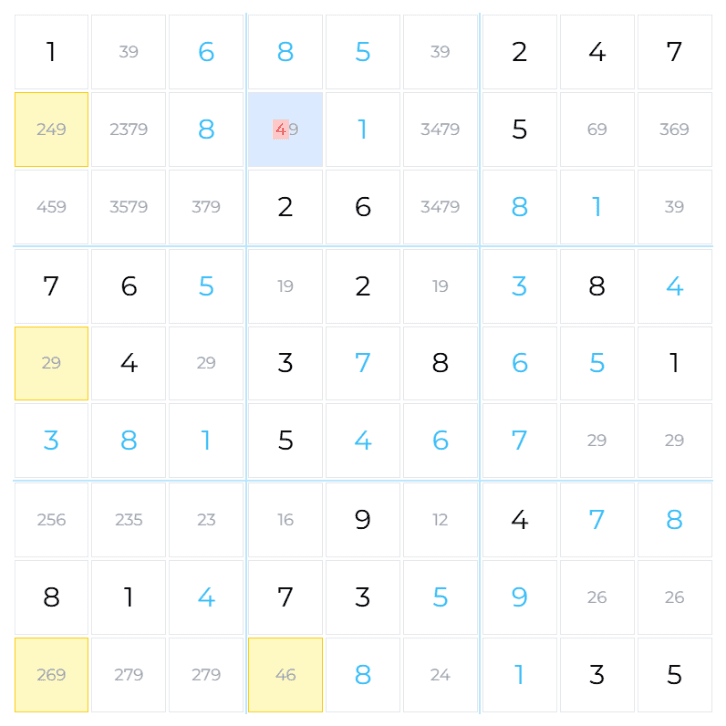
WXYZ-Wing Type 1 on Candidates 2, 4, 6, 9
WXYZ-Wing Type 1: The four cells J1, B1, E1, J4 contain in total 2/4/6/9, with the hinge on J1.
Analysis: The non-restricted candidate 4 determines the wing cells (in yellow), and one of those 4s must be true.
Elimination
Therefore, 4 can be removed from B4.
Why It Works
The logic is elegant and builds on locked sets:
The 4 cells form a locked set with candidates {2, 4, 6, 9}
Each of these 4 digits must go in exactly one of the 4 cells
The digit 4 is non-restricted — it appears in cells that can't all see each other
Since 4 must go in one of those cells, at least one instance of 4 in the pattern will be the solution
Any cell that can see ALL 4s in the pattern will definitely "see" the final 4
Therefore, we can safely eliminate 4 from those cells
Visual representation:
Four cells form a locked set. The digit 4 is non-restricted and can be eliminated from cells seeing all its instances.
Why Non-Restricted Matters
We eliminate the non-restricted candidate because its cells don't all see each other — meaning an external cell CAN potentially see all of them. For restricted candidates (where all instances see each other), any external cell would only see some instances, not all, making elimination impossible.
Detection Tips
Start with Smaller Wings
Master Y-Wing and XYZ-Wing first. WXYZ-Wing uses the same logic, just with more cells.
Look in Boxes
Many WXYZ-Wings involve cells clustered in one or two boxes. Start your search in areas with multiple bi-value and tri-value cells.
Same Logic as XYZ-Wing
WXYZ-Wing is just XYZ-Wing with one more cell. If you understand that pattern, WXYZ follows naturally — same locked set logic, same "at least one Z must be true" reasoning.
Must Have Exactly One Non-Restricted Candidate
If all candidates are restricted, or if more than one is non-restricted, the pattern doesn't work as a standard WXYZ-Wing.

 Advanced