Minimal Sudoku
Alternating Inference Chain example showing a 5-node chain eliminating candidate 9
Learn Section

Alternating Inference Chains

The Master Chain Technique

By Minimal Sudoku TeamLast updated:

An Alternating Inference Chain (AIC) is a chain of candidates connected by alternating strong and weak links. Most chain techniques — X-Cycles, XY-Chains, Y-Wings — are specific cases of AICs.

Quick Summary
  • What: Chains alternating between strong and weak links
  • Links: Strong = if A is false, B must be true. Weak = if A is true, B must be false
  • Result: Eliminations or placements, depending on how the chain ends

How It Works

🎯 The Alternating Principle
A chain alternates between strong and weak links. Because inferences flip at each step, the two ends of the chain constrain each other. What we can conclude depends on which link types meet at the endpoints.

Every AIC is built from just two link types:

  • Strong link (=): If A is false, B must be true. Occurs when only 2 candidates remain — in a cell (bi-value) or in a unit (bi-location).
  • Weak link (-): If A is true, B must be false. Occurs when two candidates see each other (same unit or same cell).
Strong links are also weak
Every strong link doubles as a weak link. If one of two candidates must be true (strong), then if one is true, the other is false (weak). This gives the solver flexibility when building chains.

The chain alternates: strong, weak, strong, weak… When the chain loops back to its starting node, the two links meeting at that node determine the outcome.

Alternating Inference Chain structureFive nodes connected by alternating strong and weak links: A strong B weak C strong D weak EABCDEstrongweakstrongweak
Each node is a candidate (digit in a cell). Links alternate between strong and weak.

Elimination

🎯 Weak-Weak Discontinuity
When a chain loops back and two weak links meet at the same node, that candidate cannot be true. If it were true, the chain would force it to be false — a contradiction. Eliminate it.

This is the most common AIC result. The logic:

  • Assume the starting candidate is true.
  • Follow the chain: weak → the next node is false → strong → the next is true → and so on.
  • The chain arrives back at the start and forces it false.
  • True and false at the same time? Impossible. The candidate is eliminated.
ABDA
Two weak links meet at A → A is eliminated.

Example: Elimination

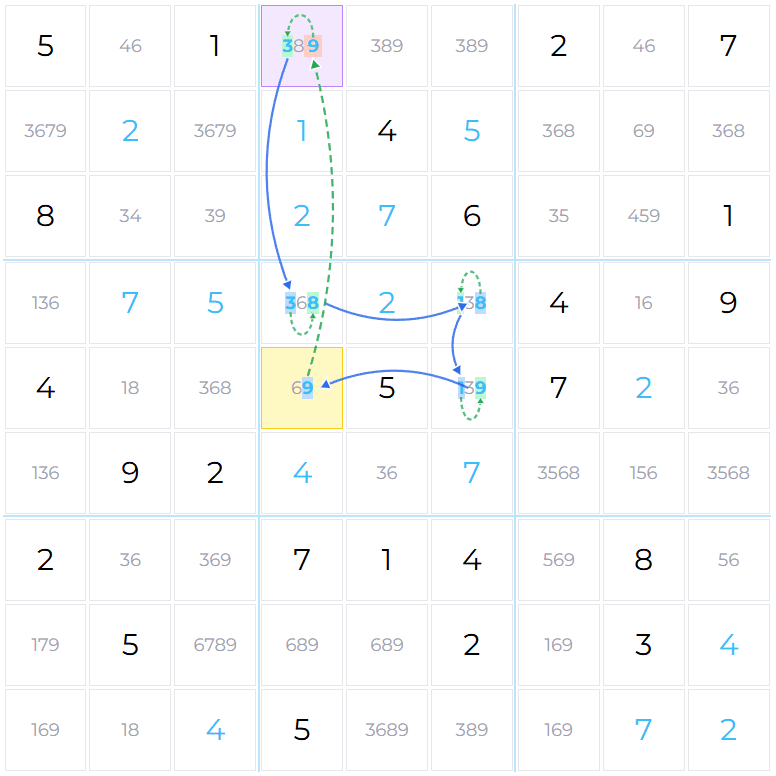
This 5-node chain eliminates 9 from R1C4. The purple cell is the target; the yellow cell is where the chain turns back.
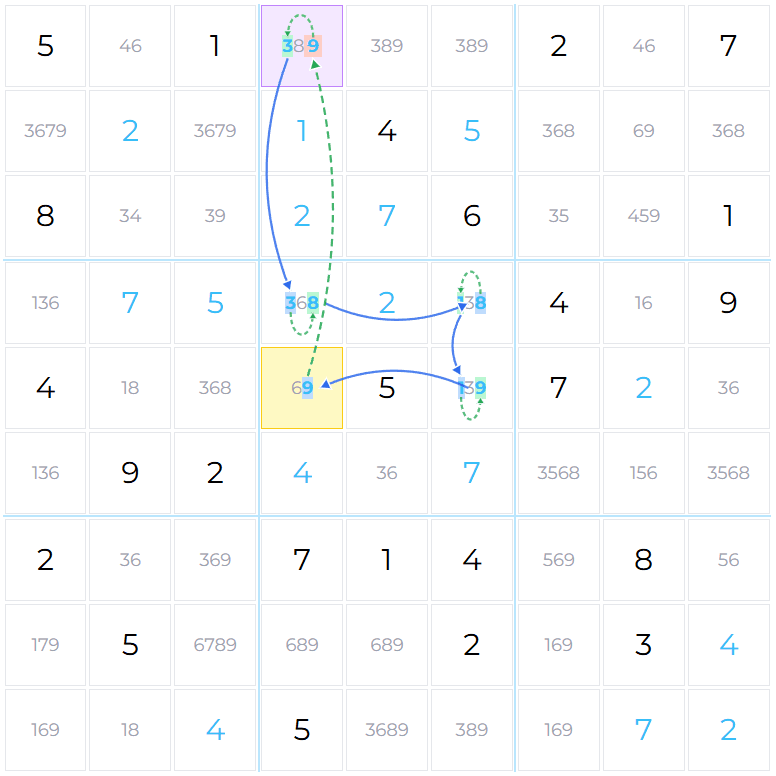
AIC example: 5-node chain through digits 9, 3, 8, and 1 eliminating 9 from R1C4

Blue solid = strong links. Green dashed = weak links. Purple = target. Yellow = chain endpoint.

Follow the chain

Assume 9@R1C4 is true, then follow the inferences:

1.Start: assume 9@R1C4 is ON
2.── weak → 3@R1C4 must be OFF (same cell)
3.══ strong → 3@R4C4 must be ON (only 2 places for 3 in column 4)
4.── weak → 8@R4C4 must be OFF (same cell)
5.══ strong → 8@R4C6 must be ON (only 2 places for 8 in row 4)
6.── weak → 1@R4C6 must be OFF (same cell)
7.══ strong → 1@R5C6 must be ON (only 2 places for 1 in column 6)
8.── weak → 9@R5C6 must be OFF (same cell)
9.══ strong → 9@R5C4 must be ON (only 2 places for 9 in row 5)
10.── weak → 9@R1C4 must be OFF (both see each other in column 4)

The chain reaches back to the start — both ends point at 9@R1C4 via weak links. Whether it's ON or OFF, the chain forces a contradiction. Remove 9 from R1C4.

Notice the pattern
Every weak link here is a same-cell link (bi-value), and every strong link is a bi-location link (only 2 places in a unit). This mix of link types is what makes AICs more powerful than X-Cycles (single-digit only) or XY-Chains (bi-value only).

Placement

🎯 Strong-Strong Discontinuity
When a chain loops back and two strong links meet at the same node, that candidate must be true. If it were false, both strong links would force it to be true — a contradiction. Place it.

The logic:

  • Assume the starting candidate is false.
  • Follow the chain: strong → the next node is true → weak → the next is false → and so on.
  • The chain arrives back at the start and forces it true.
  • False and true at the same time? Impossible. The candidate is placed.
ABDA
Two strong links meet at A → A is placed.

Placements are rarer than eliminations but more powerful — they solve a cell outright.

Continuous Loop

🎯 Off-Chain Eliminations
When a chain forms a perfect loop — every link alternates cleanly with no discontinuity — no single candidate is proven true or false. Instead, candidates outside the loop that see both ends of a weak link can be eliminated.

In a continuous loop, one of each weak-linked pair must be true. Any outside candidate that would be killed by either option is dead no matter what.

Same logic as coloring
If you know 3D Medusa's dual-color elimination, this is the same idea. The loop's alternating nodes play the role of the two colors.

Example: Continuous Loop

This 6-node loop produces four off-chain eliminations. The chain visits digits 2, 4, and 6 across columns 4, 7, and 9.
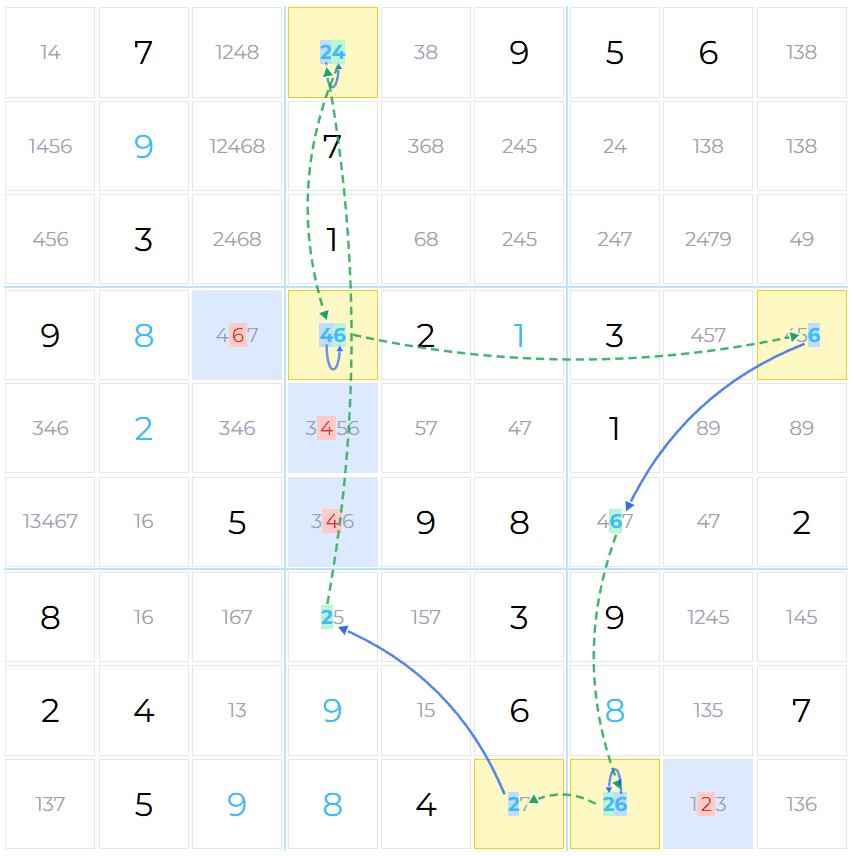
AIC continuous loop example: 6-node loop through digits 2, 4, and 6 with four off-chain eliminations

Blue solid = strong links. Green dashed = weak links. Yellow = loop nodes. Blue shaded = eliminated candidates.

Follow the loop

1.Start: assume 2@R1C4 is ON
2.══ strong → 4@R1C4 must be OFF (only 2 candidates in this cell)
3.── weak → 4@R4C4 must be ON (both see each other in column 4)
4.══ strong → 6@R4C4 must be OFF (only 2 candidates in this cell)
5.── weak → 6@R4C9 must be ON (both see each other in row 4)
6.══ strong → 6@R6C7 must be OFF (only 2 places for 6 in box 6)
7.── weak → 6@R9C7 must be ON (both see each other in column 7)
8.══ strong → 2@R9C7 must be OFF (only 2 candidates in this cell)
9.── weak → 2@R9C6 must be ON (both see each other in row 9)
10.══ strong → 2@R7C4 must be OFF (only 2 places for 2 in box 8)
11.── weak → 2@R1C4 must be ON (both see each other in column 4)

The chain returns to the start with no contradiction — it's a perfect loop. No single candidate is proven true or false, but every weak link locks a pair: one end must be ON. Any outside candidate seeing both ends of a weak link is dead either way.

Off-chain eliminations

RemoveReason
4 @ R5C4Sees 4@R1C4 and 4@R4C4
4 @ R6C4Sees 4@R1C4 and 4@R4C4
6 @ R4C3Sees 6@R4C4 and 6@R4C9
2 @ R9C8Sees 2@R9C7 and 2@R9C6
Strong links can act as weak
Some strong links in this loop double as weak links — when only two options exist, both directions of inference hold. The chain uses whichever role is needed at each step.

Tips

  • Learn the building blocks first. X-Cycles (single-digit AICs) and XY-Chains (bi-value AICs) are easier entry points. Once those click, general AICs are a natural extension.
  • Focus on strong links. They're rarer and more constrained. Find bi-value cells and bi-location pairs first, then connect them with weak links.
  • Let the solver find long chains. Chains beyond 6–8 nodes are impractical to spot by hand. Focus on short chains manually; use the solver for complex ones.
The unified view
Many named techniques are just short AICs: Y-Wing is a 3-node AIC, X-Cycle is a single-digit AIC, XY-Chain is a bi-value AIC. Understanding AICs means understanding the principle behind all of them.
XY-ChainAdvanced

XY-Chain

A common AIC type using only bi-value cells — the best entry point to chain logic.