X-Cycle Discontinuous Loops
Part 2: Placements and Eliminations at the Discontinuity
This is Part 2 of X-Cycle. If you have not covered fundamentals yet, start with X-Cycle Part 1. Here we focus on loops with exactly one flaw in alternation, called a discontinuity.
- Structure: One odd-length loop with exactly one discontinuity
- Strong-Strong: Candidate at the discontinuity is forced TRUE (placement)
- Weak-Weak: Candidate at the discontinuity is forced FALSE (elimination)
- Use Case: Great for stalled expert grids where continuous loops find nothing
The Concept
A discontinuity means alternation breaks at one node: either two strong links touch, or two weak links touch.
For clean X-Cycle inference, the loop should have exactly one discontinuity. That single flaw creates a forced conclusion at the discontinuity node.
Parity and Loop Shape
- Perfectly alternating (continuous) loops are even-length.
- Single-discontinuity loops are odd-length.
- If you detect multiple discontinuities, re-check your links before applying conclusions.
Strong-Strong Discontinuity
When two strong links meet at one node, assume that node is false and walk the chain. The chain forces conflicting truths, so the assumption fails.
Weak-Weak Discontinuity
When two weak links meet at one node, assume that node is true and walk the chain. The chain returns a contradiction, so the node cannot be true.
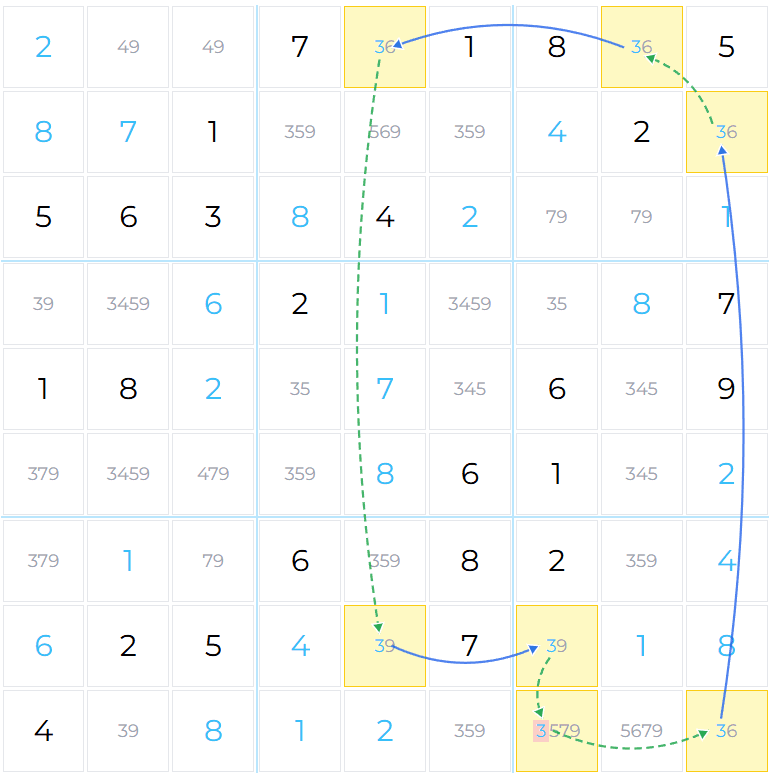
+1[C3]-1[C7]+1[G7]-1[G2]+1[H3]-1[C3]

If C3 is set to 1, the chain returns to C3 as not-1.
Contradiction -> remove 1 from C3.
Worked Example
X-Cycle (Placement) on Digit 8
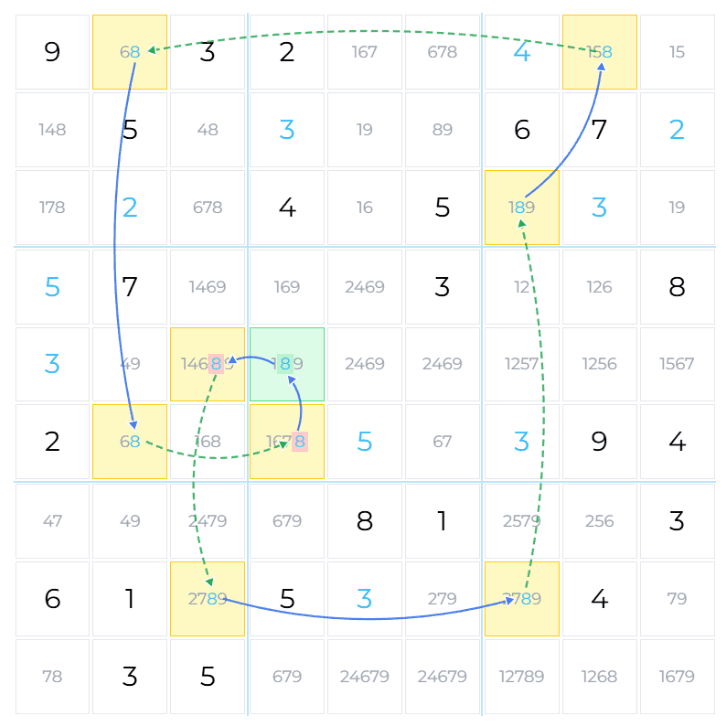
This grid shows a discontinuous X-Cycle on digit 8 with a strong-strong discontinuity.
Two strong links meet at R5C4. If R5C4 were not 8, the chain would force an impossible configuration elsewhere in the loop.
How to Detect Quickly
Build from strong links first
Track S/W labels explicitly
Look for one odd-node loop
Test the junction with contradiction logic
Apply only the local conclusion
Related Techniques
Chain Techniques
AdvancedX-Cycle Fundamentals
Review continuous loops, core link logic, and off-chain elimination patterns.
ExpertAlternating Inference Chains
Generalize these discontinuity ideas to multi-digit chain logic.