
Locked Candidates
Box-Line Interactions for Powerful Eliminations
Locked Candidates is a family of techniques that exploit the intersection between 3×3 boxes and lines (rows/columns). When candidates are "locked" to specific cells at these intersections, eliminations follow.
- Two types: Pointing Pairs/Triples and Claiming Pairs/Triples
- Core idea: When candidates in one unit are confined to an intersection with another unit
- Result: Eliminate candidates from the non-intersecting part of the other unit
- Difficulty: Intermediate — bridge between basic and advanced techniques
The Concept
Every 3×3 box intersects with exactly 3 rows and 3 columns. At each intersection, there are 3 cells. Locked Candidates techniques use these intersections to create eliminations.
The Two Types
Candidate in a box is confined to one row/column.
→ Eliminate from the rest of that row/column.
Candidate on a row/column is confined to one box.
→ Eliminate from the rest of that box.
These are mirror techniques — same logic, different starting points.
Type 1: Pointing Pairs & Triples
Starting point: A 3×3 box
If a candidate within a box can only appear in cells that are all on the same row (or column), the candidate "points" outward. Since the box will definitely place that candidate on that line, no other cell on the line can have it.
Box 1:                    Row 2 continues:
┌─────────────────┐
│  .  │  .  │  .  │
│─────│─────│─────│
│ [5] │ [5] │  .  │  →→→  │  ✗  │  ✗  │  ✗  │  ✗  │  ✗  │  ✗  │
│─────│─────│─────│
│  .  │  .  │  .  │       (5 eliminated from rest of row 2)
└─────────────────┘
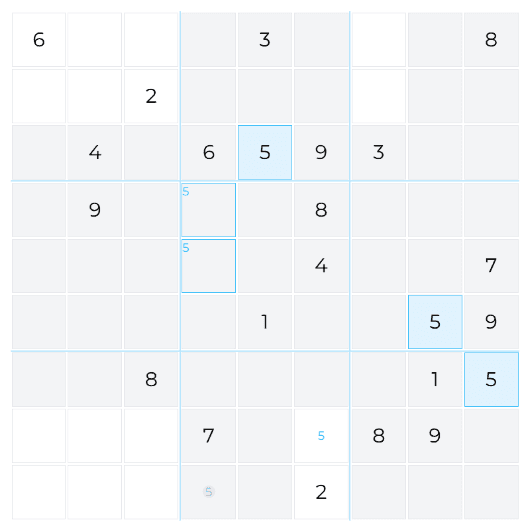 Intermediate
Pointing Pairs & Triples
Complete guide with step-by-step examples and detection tips.
Type 2: Claiming Pairs & Triples
Starting point: A row or column
If a candidate on a row (or column) can only appear in cells that are all in the same box, the line "claims" those cells for that candidate. Since the line will definitely place that candidate in this box, no other cell in the box can have it.
Row 2: │ . │ . │ . │ [7] │ [7] │ . │ . │ . │ . │
                       ↓    ↓
                    These are in Box 2

Box 2:
┌─────────────────┐
│ [7] │ [7] │  ✗  │  ← Row 2's 7 must be here
│─────│─────│─────│
│  ✗  │  ✗  │  ✗  │  ← Eliminate 7 from other cells in box
│─────│─────│─────│
│  ✗  │  ✗  │  ✗  │
└─────────────────┘IntermediateClaiming Pairs & Triples
The mirror technique — when lines claim candidates in a box.