
Naked Pairs
Two Cells, Two Candidates, Powerful Eliminations
Naked Pairs is one of the most useful intermediate Sudoku techniques. When two cells in the same row, column, or box contain exactly the same two candidates (and nothing else), those candidates must go in those cells — allowing you to eliminate them elsewhere.
- What: Two cells with exactly the same two candidates
- Where: Both cells must be in the same row, column, or box
- Result: Eliminate those two candidates from other cells in the shared unit
- Difficulty: Intermediate — requires candidate notation
The Concept
Imagine two cells in a row that both contain only candidates 3 and 7. We don't know which cell gets the 3 and which gets the 7, but we do know that these two cells will "use up" both the 3 and 7 for that row.
This means no other cell in the row can contain 3 or 7 — we can eliminate them!
The Golden Rule
How to Find Naked Pairs
Look for bi-value cells
Find matching cells in the same unit
Verify exact match
Eliminate from the shared unit
Practical Example
Naked Pair on 3 and 7
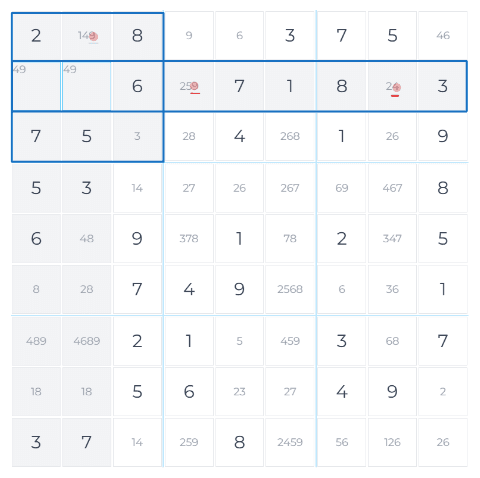
In row 4, we find two cells with identical candidates:
- R4C2: Candidates 3, 7
- R4C8: Candidates 3, 7
These cells form a Naked Pair in row 4. One will be 3, the other will be 7 — we just don't know which yet.
These eliminations might create Naked Singles or enable other techniques!
Why It Works
The logic is simple but powerful:
- Two cells, two candidates: a perfect 1-to-1 match.
- The two candidates will be distributed between these two cells.
- Therefore, neither candidate can appear anywhere else in the unit.
Row 4:
│ ? │[3,7]│ ? │ ? │ ? │ ? │ ? │[3,7]│ ? │

Either: Cell 2 = 3, Cell 8 = 7
   Or: Cell 2 = 7, Cell 8 = 3

Either way: 3 and 7 are "claimed" by these cells!
Naked Triples & Quads
The Naked Pair concept extends to larger groups:
2 cells, 2 candidates
3 cells, 3 candidates
4 cells, 4 candidates
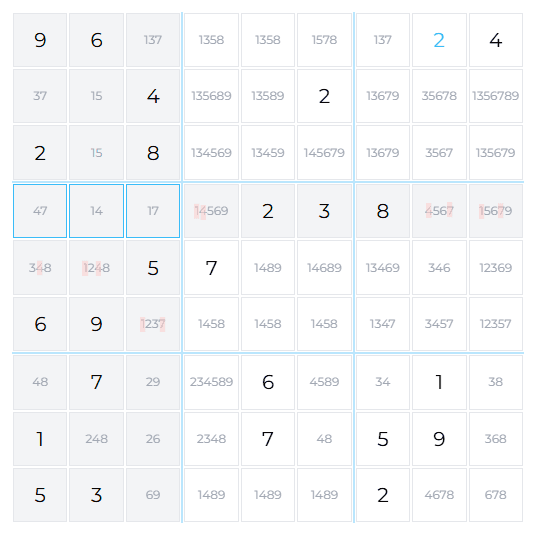 Intermediate
Naked Triples & Quads
Learn the extended versions of Naked Pairs for more complex situations.