Hidden Triples & Quads
Find Candidates Hiding in Plain Sight
Hidden Triples and Hidden Quads extend Hidden Pairs to larger groups. When 3 (or 4) candidates can only appear in exactly 3 (or 4) cells within a unit, those cells must contain only those candidates.
- Hidden Triple: 3 candidates appear in only 3 cells within a unit
- Hidden Quad: 4 candidates appear in only 4 cells within a unit
- Result: Eliminate all OTHER candidates from those cells
- Why "hidden": The cells have extra candidates that obscure the pattern
The Concept
The Hidden Sets rule mirrors Naked Sets: N candidates in only N cells = those cells must contain only those candidates.
| Pattern | Candidates | Cells |
|---|---|---|
| Hidden Pair | 2 candidates | in only 2 cells |
| Hidden Triple | 3 candidates | in only 3 cells |
| Hidden Quad | 4 candidates | in only 4 cells |
The Golden Rule
Hidden Triples
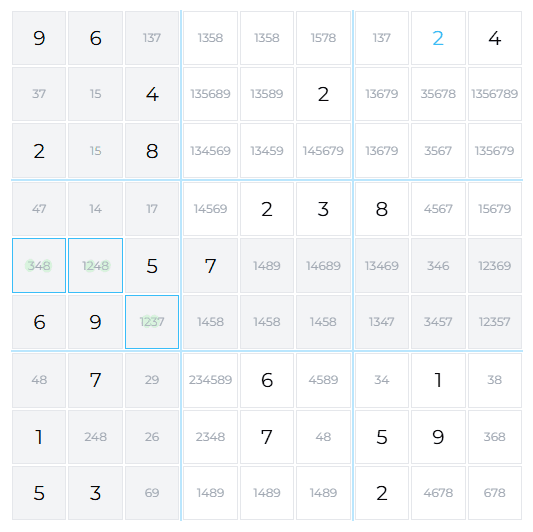
A Hidden Triple occurs when 3 candidates can only appear in exactly 3 cells within a unit. The cells likely have other candidates too — that's why the triple is "hidden."
Candidates 2, 4, 7 only appear in cells C2, C5, C8:

Row 5: │ . │[2,4,6,9]│ . │ . │[2,7,8]│ . │ . │[4,7,9]│ . │
            ↑              ↑              ↑
         Has 2,4       Has 2,7        Has 4,7

The 2, 4, and 7 ONLY exist in these 3 cells!
→ Remove 6, 9, 8, 9 (the others) from these cells.
→ Result: [2,4], [2,7], [4,7] — now a Naked Triple!
Hidden Quads
Hidden Quads follow the same logic with 4 candidates and 4 cells. They're rare and difficult to spot, but the cleanup is significant.
How to Find Hidden Triples & Quads
Pick a unit
Map candidate positions
Look for limited candidates
Find matching groups
Eliminate other candidates
Hidden vs Naked Sets
Hidden and Naked sets are mirrors of each other:
N cells have only N candidates
→ Eliminate from other cells
N candidates in only N cells
→ Eliminate from those cells
Detection Tips
Related Techniques
Hidden Sets Family
 Intermediate
Hidden Pairs
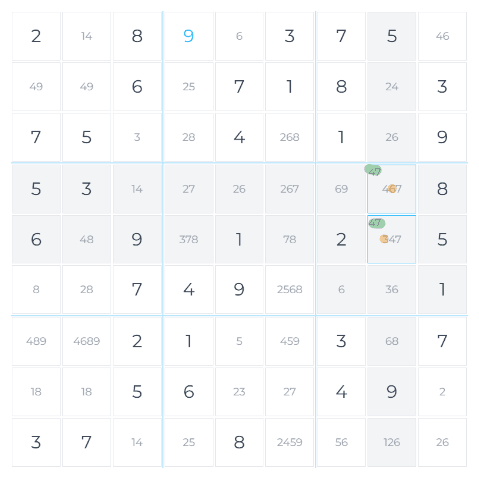
Start with the simpler Hidden Pair — same logic, easier to spot.
 Intermediate
Naked Triples & Quads
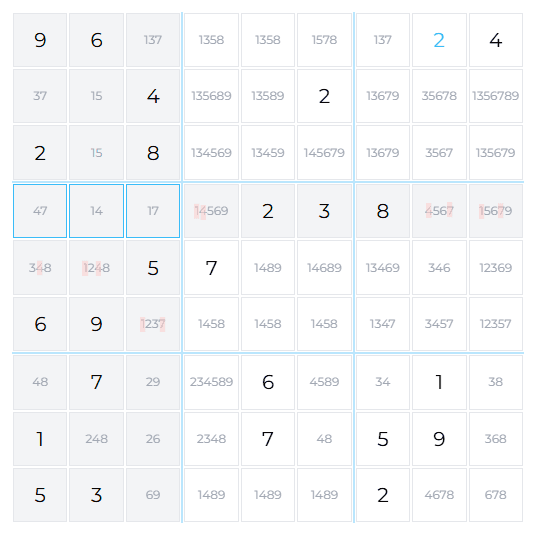
The mirror technique — N cells with only N candidates.