Closed XY-Chains
Part 2: When the Chain Closes into a Loop
By Minimal Sudoku Team•Last updated:
This is Part 2 of XY-Chains. If you are new to the strategy, start with XY-Chain (Part 1).
Quick Summary
- What changes: The two endpoints also see each other
- Shape: The chain becomes a loop
- Result: Eliminations can appear in multiple units around the loop, not only at two endpoints
- Name: Usually called Closed XY-Chain or XY-Loop
The Concept
In an open XY-Chain, you mainly eliminate from cells that see both endpoints. In a closed XY-Chain, endpoints also see each other, so the chain forms a continuous loop.
That loop structure often creates more elimination opportunities around the cycle.
Core Rule
⭕ Closed XY-Chain Outcome
When an XY-Chain closes, treat it as a loop of alternating truths. Use the loop to eliminate candidates in units constrained by opposite loop states.
Practical Effect
Closed XY-Chains are often stronger than open XY-Chains because eliminations are not restricted to one shared endpoint pair.
Worked Example
Closed XY-Chain Loop
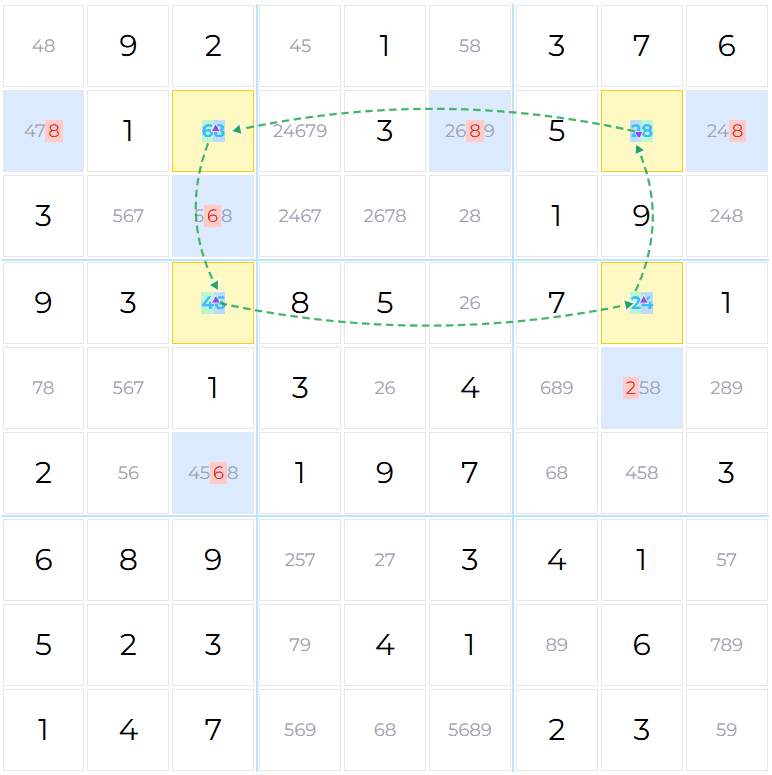
Loop:
R2C3 (8,6) → R4C3 (6,4) → R4C8 (4,2) → R2C8 (2,8) → R2C3 (8,6)
Because the chain closes, each weak-link unit can produce eliminations outside the loop.
Eliminations
- Remove 8 from R2C1, R2C6, and R2C9.
- Remove 6 from R3C3 and R6C3.
- Remove 2 from R5C8.
How to Find Closed XY-Chains
1
Find an open chain first
Build a valid XY-Chain exactly as in Part 1.
2
Test endpoint visibility
Check whether the two endpoints also see each other in a row, column, or box.
3
Confirm loop logic
Verify the chain still alternates correctly and forms a consistent loop.
4
Scan loop-adjacent units
Look for candidates constrained by opposite loop states and apply eliminations.
Naming
XY-Cycle vs Closed XY-Chain
Closed XY-Chain (or XY-Loop) is the clearest name for learners. We avoid XY-Cycle to reduce confusion with X-Cycle, which is a different strategy family.
Related Techniques
Chain Techniques
 Advanced
XY-Chain (Part 1)
Review open-chain endpoint eliminations before tackling closed loops.