
Chute Remote Pairs
Chute-Based Contradiction Chains
Chute Remote Pair is a practical shortcut: find a matching pair, check a small set of chute cells, then remove a candidate from cells that see both ends.
- Find: Two cells with the same pair (here, 3/8)
- Check: Key chute cells block one digit of that pair
- Eliminate: From every cell that sees both endpoints (one or both digits, depending on what is blocked)
- Use when: You are comfortable with candidate chains and contradiction proofs
The Concept
A chute is a strip of three boxes: either horizontal (rows 1-3, 4-6, 7-9) or vertical (columns 1-3, 4-6, 7-9).
In this strategy, you start from two matching bi-value cells (same pair, same two candidates). Then you use chute restrictions to decide which digit becomes removable.
Chain ends: the two endpoint cells of the pair pattern.
See: share a row, column, or box.
Key Chute Cells
For new readers, this is the most important setup step: identify the key chute cells before doing any eliminations.
In this screenshot, key chute cells are R7C4, R7C5, and R7C6 (yellow cells in Box 8). Candidate 3 is blocked there, so eliminations are on 8.
The Golden Rule
Chute geometry helps you decide which digit is blocked first. That makes the final elimination step much easier.
Worked Example
Digit 3 in a Chute Remote Pair
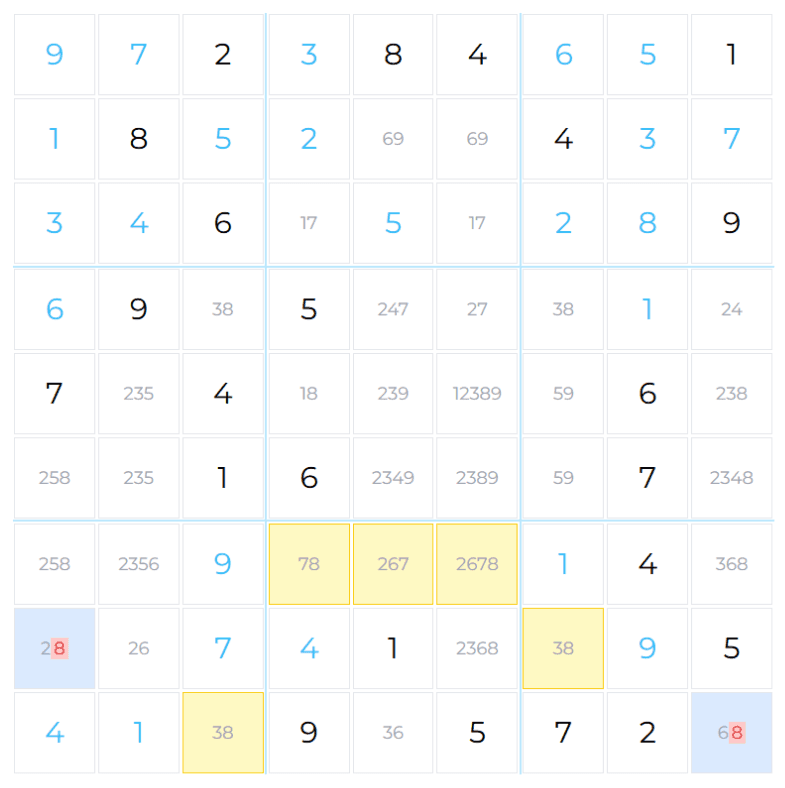
In this position, digit 3 is not in the key cells of Box 8. The remote pair endpoints are:
It does not matter whether those key cells are given clues or solved values. What matters is only that candidate 3 is unavailable there.
- R9C3 = (3,8)
- R8C7 = (3,8)
- Key chute cells: R7C4, R7C5, R7C6
Follow this order:
- Check the key chute cells R7C4/R7C5/R7C6.
- Candidate 3 is blocked there.
- So the removable digit becomes the paired candidate 8.
- Now remove 8 from cells that see both endpoints.
- Remove 8 from R8C1.
- Remove 8 from R9C9.
This is possible because 3 cannot be placed in R7 and in columns 4, 5, and 6, which locks the pair logic through the chute.
Why This Works
- Endpoints are R9C3 and R8C7, both {3,8}.
- Key chute cells are R7C4, R7C5, R7C6, and they contain no 3.
- So in Box 8, digit 3 must be placed in the lower two rows of that box (here: R8C6 or R9C5).
- If R9C3 = 3, then row 9 already has a 3, so R9C5 cannot be 3.
- If R8C7 = 3, then row 8 already has a 3, so R8C6 cannot be 3.
- If both endpoints were 3, both spots for 3 in Box 8 would be blocked. That is impossible.
- Therefore, endpoints cannot both be 3, so at least one endpoint must be 8.
- Any cell that sees both endpoints cannot be 8, so remove 8 from R8C1 and R9C9.
Takeaway: this is a contradiction chain. If both endpoints are the blocked digit, the grid breaks. So at least one endpoint must be the other digit.
How to Find It
Find matching bi-value pairs
Check chute context
Mark key chute cells
Identify remote endpoints
Eliminate from shared visibility
Single vs Double Eliminations
Single Elimination (Common)
One pair digit is blocked in key chute cells, so remove the other digit from valid targets.
Double Elimination (Rare)
Both pair digits are blocked in key chute cells, so valid targets can lose both digits.
Advanced positions can produce extra either-end eliminations. Verify them carefully before removing candidates.
Modern solvers often classify this as a special case of AIC/chaining.
Related Techniques
Related Techniques
ExpertAlternating Inference Chains
See the broader chain framework behind contradiction-based eliminations.