
Aligned Pair Exclusion
Testing Candidate Combinations
By Minimal Sudoku Team•Last updated:
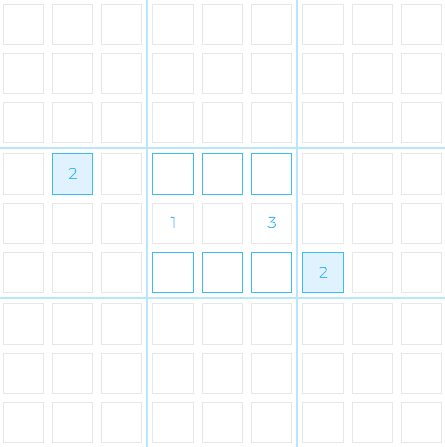
Aligned Pair Exclusion (APE) tests candidate combinations in aligned cells. If every possible pairing of a candidate would create an invalid state, that candidate can be eliminated.
Quick Summary
- Focus: Two or more cells aligned in a row/column
- Method: Test all possible value combinations
- Logic: If a candidate leads to contradiction in ALL pairings, eliminate it
- Difficulty: Expert — requires systematic combination testing
The Concept
When two cells are aligned (same row or column) and share visibility with other important cells, you can test which candidate combinations are actually possible.
If a specific candidate, when paired with ANY candidate from the other cell, leads to an invalid state (empties a cell or creates a duplicate), that candidate is impossible.
The Method
⚡ APE Process
For two aligned cells A and B: test each candidate in A with each candidate in B. If candidate X in A causes a contradiction with EVERY possible candidate in B, then X can be eliminated from A.
Cell A: [1,2,3]  |  Cell B: [2,3,4]  (same row)
                 |
Test A=1:        |
  with B=2: Valid? Check...
  with B=3: Valid? Check...
  with B=4: Valid? Check...

If A=1 fails with ALL of B's options → Eliminate 1 from A
Example Logic
What makes a combination "fail"?
- A cell in the same box/row/column would have no candidates left
- Two cells in the same unit would be forced to the same value
- A chain of forced values leads to contradiction
Complex Analysis
APE requires analyzing each combination against the entire grid state. It's essentially a structured form of "what if" testing.
Detection Tips
Look for Constrained Pairs
APE works best when two aligned cells have limited candidates and share visibility with nearly-complete units.
Use Software
APE is tedious to perform manually. Most solvers use software to test combinations systematically.
Last Resort
APE is typically used when other techniques fail. It's powerful but time-consuming.